
The government is moving to localise core technologies for physical artificial intelligence (AI), an area it has largely relied on foreign products for. It aims to secure high-performance "world models" and a homegrown simulator to build a next-generation physical AI foundation model that can be applied in industrial sites such as manufacturing and logistics.
The Ministry of Science and ICT and the Institute of Information & Communications Technology Planning & Evaluation (IITP) held a kickoff briefing for the Physical AI Leading Technology Development project on Monday at LG Science Park in Magok, Seoul.
The project’s core is to bind the world model, robot foundation model and domestic simulator technologies needed to implement physical AI into a single demonstration system. It focuses on securing the foundational technology needed so AI trained in virtual environments can operate reliably in the real physical world, rather than stopping at the development of individual robot technologies.
◆ Developing original "world model" technology...10 industry-academia-research participants including LG Electronics and KT
Physical AI refers to AI that operates in the physical world, such as robots, autonomous driving and manufacturing automation. Because it moves in real space, errors can lead to casualties or accidents at industrial sites. For this reason, extensive training and verification in a virtual environment is essential before deployment in real environments.
The key infrastructure for this is the world model. A world model is a technology that supports AI learning and decision-making by predicting changes in the world. It predicts how the surrounding environment will change when a robot takes a specific action, and acts as a platform that supports the advancement of physical AI by generating large volumes of synthetic data.
South Korea’s physical AI ecosystem has so far relied mostly on foreign products for such simulation platforms. Through this project, the ministry will secure independent original world model technology and verify domestic simulator technology linked to it.
The project includes 10 industry, academia and research participants: LG Electronics as lead institution, along with Minds AI, Holiday Robotics, Robotis, CrowdWorks, Alchera, KT, Korea Advanced Institute of Science and Technology, Seoul National University and the Telecommunications Technology Association.
Kim Young-jun (김영준), head of LG Electronics' AI Robot Lab, introduced the project direction for leading physical AI technologies, including the world model. Kim said, "We plan to quickly bring together the capabilities of companies that have already researched or commercialised physical AI, supplement weaknesses with a focus on real sites, and proceed with global-level model verification."
The world model will be advanced by applying various methodologies and combining them by complementing each other’s strengths and weaknesses. The project will develop three models in parallel to pursue an optimal world model: a physics-consistency methodology centred on 3D spatial reconstruction, an exception-situation augmentation model that creates virtual scenes with potential accidents for training and verification, and a lightweight predictive model that simplifies the complex world into simplified representations to improve computing speed and accuracy.
Kim explained, "Just as people can imagine the outcome in their heads when they picture someone dropping a cup, the role of the world model is to enable a robot to judge actions it should not take through that kind of imagination."
◆ 34 billion won over two years...targeting a 20 percentage-point improvement in real robot task success rates
The ministry will invest a total of 34 billion won over two years starting this year. This year’s budget is 15 billion won. The project period runs from May 2026 to December 2027.
The ministry set a target of raising the final task success rate of real robots by more than 20 percentage points compared with when the world model is not applied, by improving the world model’s real-world simulation performance and the transfer performance of robot foundation models. According to the ministry, this is a target that significantly exceeds 14.5 percentage points, which it said is presented as the current global best level.
To do this, the government and participating institutions will build a demonstration pipeline that runs from "world model training - linkage to robot foundation model - demonstration and performance evaluation - case analysis and retraining." They plan to raise technological completeness through repeated verification conducted four times over two years, and in the final stage to carry out demonstrations at actual manufacturing and logistics sites.
Kim said, "The goal is to create a circular structure in which we apply quickly, find problems and then improve them," adding, "New, unexpected problems may emerge, but a good team must be able to improve difficult problems quickly."
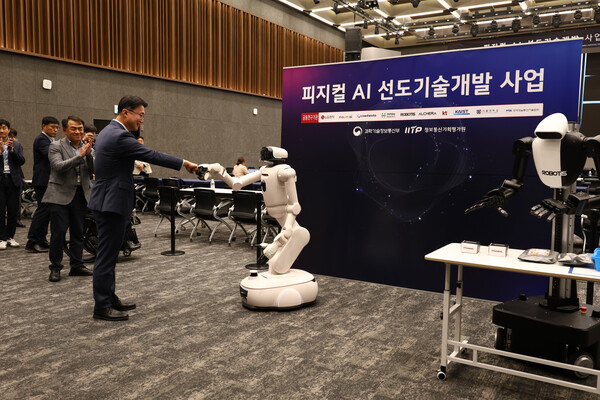
The kickoff briefing also included demonstrations of LG Electronics' CLOiD robot and Robotis' AI Worker robot. The two robots exchanged fist bumps and finger-heart gestures, showing physical AI-based interaction capabilities.
Research and development outcomes from the project will be spread across industry. Kim said, "We plan to support the results in a form that small and medium-sized enterprises can easily download and use through the open-source ecosystem."
But building large-scale data storage and management systems and supporting computing infrastructure were cited as issues to be solved. Kim said, "Because the world model is a technology that must store large amounts of data such as video and train based on it, it requires more storage than expected," adding, "In the long term, we need a system that can be commonly managed and used at the national level."
The government stressed it will support the development of world-class world models based on an industry-academia-research cooperation system. It said success in localising world model development would also help in terms of energy and security, including simulations for nuclear development.
Hong Jin-bae (홍진배), head of IITP, said, "True physical AI will be completed when we optimise vision, language and action models and even hardware on the foundation of a world model that describes the physical laws of the real world."
Ryu Je-myeong (류제명), second vice minister of the Ministry of Science and ICT, said, "Just as researchers achieved the miracle of localising telephone exchanges with the resolve to write a blood pledge during the development of TDX in the past, if this project is pursued with that kind of resolve and sense of mission, we will be able to leap to become a physical AI powerhouse." He added, "The government will also actively support by bringing together all policy capabilities so that challenges and innovation in research sites can quickly bear fruit."
 Jin-ho Lee
jhlee26@d-today.co.kr
Jin-ho Lee
jhlee26@d-today.co.kr