
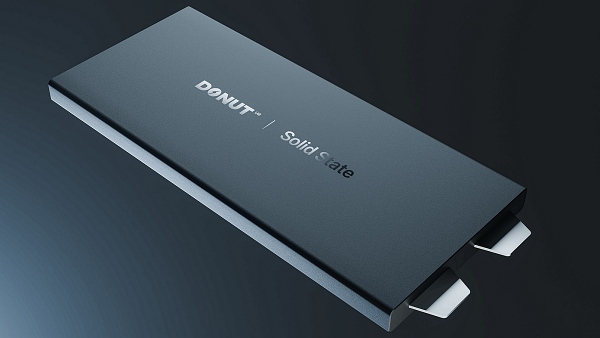
A probe has found that the key technology behind Donut Lab, which drew attention with its next-generation solid-state battery, may in fact be a conventional lithium-ion battery. As controversy over technology verification spreads, concerns are also growing about investor protection and corporate disclosures.
On June 8 (local time), electric vehicle-focused outlet Electrek reported that battery researcher Gyros, working with more than 20 external battery experts, analysed Donut Lab's test cell and concluded it was likely a lithium-ion battery, not the sodium-ion-based solid-state battery the company claimed.
The controversy began with battery performance Donut Lab unveiled at CES 2026. At the time, the company drew industry attention by claiming an energy density of 400 Wh/kg, a lifespan of 100,000 cycles and 5-minute charging. Independent tests conducted later did not verify key performance indicators, and industry sources have questioned whether those figures can be achieved.
The investigation team cited voltage curves and cell swelling data as key evidence. The test cell showed voltage characteristics of about 3.7 to 3.8 volts in the 50 percent state-of-charge range, which it described as a pattern commonly seen in high-nickel lithium-ion batteries. Sodium-ion batteries are known to show lower voltage characteristics in that range.
Cell swelling characteristics were also analysed as being similar to lithium-ion batteries. Experts pointed to a typical swelling curve seen in graphite anodes that was also confirmed in Donut Lab's test cell. The calculated energy density was estimated at about 298 Wh/kg, well short of the company's stated target of 400 Wh/kg.
Questions were also raised about the technology supply chain. The investigation found the technology was provided by German company CT Coatings, manufactured by Nordic Nano, with Donut Lab responsible for commercialisation. Nordic Nano was reported to have no experience in mass-producing battery cells.
Commercialisation claims also became a subject of controversy. Donut Lab mentioned shipments of vehicles for consumer delivery in the first quarter of this year, but internal materials disclosed later said initial production volumes were used for internal vehicles to improve manufacturing processes. The company was also reported to have acknowledged that the 400 Wh/kg cell unveiled at CES was not applied to actual mass-produced vehicles.
Its fundraising process has also come under scrutiny. Donut Lab secured more than 1,300 shareholders, many of whom were believed to be small investors. The company said its valuation was assessed at about $1.25 billion after its CES presentation, but it did not release independent verification data for its core technology.
The controversy is spreading beyond a simple technology verification issue to one of investor protection. Local reports said Finnish financial authorities and investigative agencies are also reviewing the matter.
Industry sources see whether there is a significant gap between Donut Lab's claimed battery performance and its actual technology level as a key issue going forward.
 Jinju Hong
hongjj@d-today.co.kr
Jinju Hong
hongjj@d-today.co.kr