
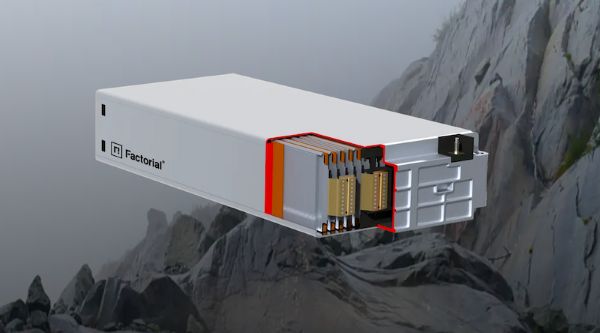
U.S. solid-state battery company Factorial Energy has completed a Nasdaq listing and is moving to expand commercialization of next-generation batteries. Factorial, which is working with global automakers including Mercedes-Benz, Hyundai Motor and Kia, and Stellantis, plans to use the funds it has secured to expand its business beyond electric vehicles into defense and aerospace.
Electrek, an electric vehicle-focused media outlet, reported on June 8 (local time) that Factorial Energy completed a merger with special purpose acquisition company Cartesian Growth Corp III and began trading on Nasdaq that day. Its ticker symbols are FAC and FACWW.
The merger values the company at about $1.3 billion. Factorial secured about $110 million through the transaction and plans to invest it in commercialization of next-generation batteries and expanding production. Investment targets include not only EVs but also defense, aerospace, hyperscale data centers and robotics.
Factorial is drawing attention for validating its solid-state battery technology in real vehicle conditions. The company said it applied a solid-state battery cell jointly developed with Mercedes-Benz last year to a modified EQS vehicle and drove 745 miles, or about 1,200 km, on a single charge.
Mercedes-Benz explained at the time that it increased usable energy by about 25 percent while keeping the vehicle's size and weight similar to the existing model. Markus Schaefer (마르쿠스 셰퍼), Mercedes-Benz's chief technology officer, assessed the technology could be a "game changer" for the EV market.
Factorial is developing next-generation solid-state batteries with Mercedes-Benz as well as Hyundai Motor, Kia and Stellantis. Earlier this year, it launched what it called the first commercial solid-state battery program in the United States with Karma Automotive, accelerating preparations for commercialization.
The company is highlighting its in-house electrolyte technology, FEST (Factorial Electrolyte System Technology), as a core competitive advantage. Factorial said the technology offers higher energy density, faster charging speed and longer driving range than conventional lithium-ion batteries.
Stellantis said last year that tests showed Factorial's 77Ah solid-state battery cell maintained an energy density of 375Wh/kg for more than 600 charge and discharge cycles. It also said the battery reduced charging time from 10 percent to more than 90 percent to about 18 minutes, and is known to support up to 4C discharge performance.
Factorial is also highlighting strengths in battery pack design. It said its solid-state battery pack has about one-third the volume of conventional lithium-ion batteries and weighs up to 40 percent less. It claimed this could increase EV driving range by more than 50 percent to secure more than 600 miles, or about 965 km.
Si-you Huang (시유 황), Factorial's chief executive officer, said, "Our goal is to implement solid-state batteries at scale in the real world," adding, "We will expand the scope of technology application not only to EVs but also to drones, robotics and next-generation energy systems."
The industry is interpreting the Nasdaq listing as a signal that solid-state battery technology is moving beyond the research and development stage and entering full-scale mass production and commercialization. Attention is focusing on what results Factorial, which has completed real-vehicle validation, will deliver in the next-generation battery competition in the EV market.
 Jinju Hong
hongjj@d-today.co.kr
Jinju Hong
hongjj@d-today.co.kr