
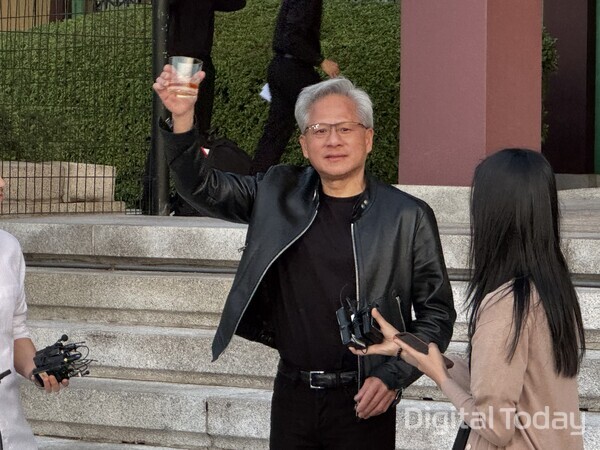
On June 8, Nvidia Chief Executive Jensen Huang (젠슨 황) attended the "Korea AI Ecosystem Reception" marking the end of his five-day trip to South Korea. "South Korea is a country unmatched in heavy industry, manufacturing, electronics and AI software," he said. "Over the next 5 years, hundreds of billions of dollars in revenue will flow into South Korea," he said, stressing his expectations for the country again.
He also drew attention by calling for active support for startups.
◆ Expanding startup support, boosting physical AI cooperation
Nvidia ecosystem partners attended the event, ranging from major companies such as Samsung Electronics, SK hynix, SK Telecom, Hyundai Motor Group, LG Electronics and Naver to AI startups including Upstage, RealWorld and Rableup, and venture capital firms including Korea Investment Partners, IMM, Atnum and SBVA.
More than 10 companies took part in the AI and robotics fields in South Korea.
Huang said the future is being made by AI startups and urged the VCs present, calling them out by name, to invest in startups. He was also reported to have told Deputy Prime Minister Bae Kyung-hoon (배경훈) that what these companies need is money and to have asked for government-level funding support.
Kim Sung-hoon (김성훈), head of Upstage, said right after the meeting, "If I sum up today's meeting in one word, it was investment."
Physical AI was also an issue. The event was attended by robotics and physical AI companies such as Doosan Robotics, RealWorld, Arobot and Robotis, as well as NC AI and Krafton. Attendees said that, from Nvidia's perspective, South Korea is its top physical AI partner outside the United States.
Ryu Jung-hee (류중희), head of RealWorld, said physical AI is a complete group project that requires everything from parts, sensors and robot manufacturing to labor data and manufacturing. Excluding China, he said, South Korea is the only country that can do that. He added that Nvidia knows this and is trying to preempt it, and that it seems to want to become the big tech company that maintains the best relationship with South Korea.
Huang also stressed during his visit that robotics is very important to South Korea and that AI and robots will maximize the country's potential.
Ahead of the event, Huang held a closed-door meeting with Deputy Prime Minister Bae, who also serves as minister of science and ICT. At the reception, the two also showed their close ties by sharing a champagne "love shot."
Bae later told reporters of four outcomes. First, the parties agreed to give South Korea priority supply of Verarubin, a next-generation AI accelerator. "We agreed to receive Verarubin with South Korea as the top priority, and to be supported without disruption for the introduction of 260,000 existing GPUs," he said. On additional supply beyond the 260,000 units, he said there would be no problem in additional projects.
The government is also pushing to host GTC, Nvidia's annual event, in South Korea. Bae said Huang views holding GTC Korea very positively in terms of building the AI ecosystem together.
On GPU price negotiations, Bae said Huang believes South Korea has three strengths in culture, geopolitics and industrial capabilities, and that this could allow South Korea to receive more price benefits than other countries.
Five universities were invited to the reception: the Korea Advanced Institute of Science and Technology (KAIST), Ulsan National Institute of Science and Technology (UNIST), Seoul National University, Korea University and POSTECH. Nvidia previously promised, through an agreement with Hyundai Motor Group and the government in October last year, to establish an AI Technology Center, its top-tier R&D hub. Huang said hiring has already begun and that the company will secure a site once staffing is in place. Nvidia's AI Technology Center is currently operated only in some countries, including Singapore, Britain and Taiwan.
◆ Beyond HBM to SOCAM...broadening memory cooperation
During this trip, Huang expanded a memory semiconductor supply chain that had been focused on HBM to cover memory for AI servers more broadly.
Ahead of the reception, he met Samsung Electronics DS Division head Jun Young-hyun (전영현) for about 15 minutes. Right after the meeting, Jun told reporters they discussed HBM supply, foundry cooperation and plans for jointly developing next-generation memory. "We have cooperated for a long time, and I think we had the best conversation today," he said. He added that they discussed mid- to long-term cooperation up to HBM5, following supply of HBM4E next year.
SK hynix CEO Kwak Noh-jung (곽노정) also attended the event.
During his visit, Huang met SK executives including SK Group Chairman Chey Tae-won (최태원) and Kwak, and said, "This year we achieved very big results with SK hynix. There will be even bigger growth in the second half of the year and next year." He also said, "Vera CPUs will also use SK hynix memory."
◆ Expanding AI infrastructure to "gigawatt-class" factories
Executives from South Korean cloud service providers including NHN Cloud, KT Cloud and Elice Group also attended the reception.
Elice Group CEO Kim Jae-won (김재원) said before the event that he planned to request an opportunity to join the Nvidia Cloud Partnership. He said partnerships had been centered on large companies, and that he would suggest opening the door to startups as well.
NHN Cloud CEO Kim Dong-hoon (김동훈) said that if the latest GPUs such as Verarubin are supplied to the South Korean market, demand will naturally follow. He said the company would actively move with Nvidia to expand GPU supply.
Naver Cloud CEO Kim Yoo-won (김유원) and SK Telecom executives also attended. During Huang's visit, the two companies each disclosed plans with Nvidia to build gigawatt-class AI factories.
Naver announced a plan to start operating 55 MW in 2027 based on its Sejong data center, expand to 200 MW in 2028 and, in the long term, scale up to the gigawatt level. SKT is moving to build an AI factory of up to 5 GW based on Nvidia's DSX platform. It aims for the first operation in South Korea in 2027.
 Seulgi Son
sageson@d-today.co.kr
Seulgi Son
sageson@d-today.co.kr