
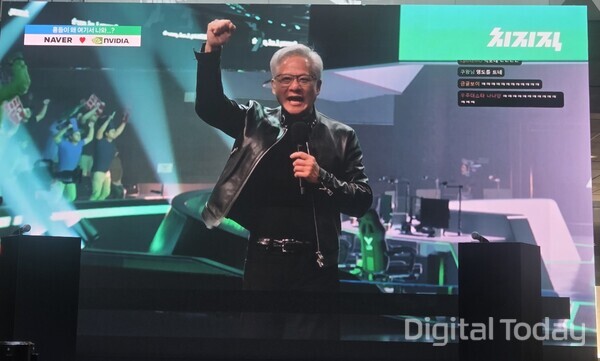
[DigitalToday reporter Daegeon Seok] Nvidia Chief Executive Jensen Huang (황젠슨) swept across South Korea’s artificial intelligence industry during a four-day visit. Potential partners spanned the entire value chain, from memory chips and foundries to data centres, AI models and robotics. It is unusual for a global company CEO to forge touchpoints with such a broad range of domestic industries in a single trip.
After arriving on June 5, Huang visited SK, Samsung Electronics, Hyundai Motor Group, Naver, LG Electronics and the game industry in turn. On the final day of his schedule, he held a "Korea AI Ecosystem Reception" on the evening of June 8 at the Yeongbin-gwan at the Shilla Hotel in Seoul, bringing together companies he had met. A total of 18 companies attended, from large firms such as Samsung Electronics, SK hynix, Hyundai Motor Group, LG Electronics, Naver and Krafton to AI and robot startups.
The lineup of attendees shows what Nvidia is trying to tie together in South Korea. Domestic partners were positioned at each stage, linking semiconductors and data centres to AI models, application services and robotics. The meeting was held behind closed doors, and generative AI, sovereign AI, AI semiconductor infrastructure, global expansion and ways to cooperate with startups were discussed, it was reported.
The thickest layer of cooperation is memory. Huang on the morning of June 8 presented a vision for "full-stack" cooperation with Chey Tae-won (최태원), chairman of SK Group, at SK’s Seorin Building in Jongno, Seoul. "SK hynix has been Nvidia’s biggest memory partner so far, and it will continue to maintain its status as the strongest memory partner," Huang said. He said the cooperation will diversify beyond AI factories into robotics and next-generation computing platforms. Nvidia also signed a partnership with SK Telecom to build an AI-specialised data centre, an "AI factory".
He also laid out the basis for demand. "Nvidia will generate $1 trillion in revenue next year alone with products such as 'Vera Rubin' and 'Grace Blackwell'," Huang said, adding that the revenue scale includes huge volumes of chips, memory, wafers and packaging. Chey said the friendship the two companies have built will become a key backdrop for global AI infrastructure, and that they are currently focusing first on building infrastructure in South Korea.
Cooperation with Samsung Electronics on memory and foundries also advanced. Jun Young-hyun (전영현), head of Samsung Electronics’ Device Solutions division and vice chairman, said after meeting Huang that they discussed supplying seventh- and eighth-generation high-bandwidth memory, HBM4E and HBM5. "In the short term, we will supply enough HBM4 or SOCAMM starting this year, and from next year we talked a lot about long-term cooperation such as HBM4E, the foundry business and HBM5," Jun said. He added that foundry cooperation is under way at 4-nanometre and 8-nanometre nodes for autonomous driving chips and Nvidia accelerator chips, and that next-generation cooperation is also being discussed. "We will work hard on our work. We will show you later with results," he said.
◆Nvidia cooperation map widens to data centres and robots
The scope of cooperation also extended beyond memory. Huang met Naver board chairman Lee Hae-jin (이해진) at Naver’s 1784 headquarters in Seongnam, Gyeonggi Province, on June 8 and presented cooperation on AI cloud and robotics. Saying it is building a 200-megawatt AI factory with Naver, he said, "If it is completed at the gigawatt scale, Naver will become a company 10 times larger than it is now." Naver is also taking part in developing open frontier AI models as a partner in the Nvidia Nemotron alliance. Lee said Naver is the only company that can meet demand in the GPU and AI market, where demand is rising rapidly.
It also expanded into mobility and robots. Huang met Hyundai Motor Group Chairman Chung Eui-sun (정의선) and reaffirmed willingness to cooperate on humanoid robots and autonomous driving, and Nvidia revealed a plan to build a data centre in Saemangeum at Hyundai’s suggestion. Nvidia and LG Electronics agreed to expand cooperation on developing humanoid and logistics robots. Robot companies including Doosan Robotics and Robotis also attended the reception. Earlier, on June 7, the third day of the trip, he met Krafton chairman Chang Byung-gyu (장병규) and NCSoft CEO Kim Taek-jin (김택진) at a PC bang to discuss cooperation on games and physical AI, widening contact points with the game industry.
Government-level discussions also dovetailed. Bae Kyung-hoon (배경훈), deputy prime minister and minister of science and ICT, held a separate meeting with Huang and discussed timely supply of the next-generation AI accelerator Vera Rubin and cooperation on the physical AI ecosystem. "There could be discussions on more than 260,000 GPUs promised during APEC last October," Bae said, mentioning building a Vera Rubin-based AI factory within the year and establishing an Nvidia R&D centre in South Korea.
The visit is being assessed as showing Nvidia’s plan to bind South Korea as a hub for building AI infrastructure, beyond relationships with parts suppliers. As cooperation expands from memory supply to data-centre operations, model development and robots, the role of domestic companies also shifts from simple demand sources to infrastructure operators. "Now is South Korea’s time," Huang said, adding that South Korea has the right cultural foundation, industrial foundation and geopolitical position.
 Daegeon Seok
d2dg@d-today.co.kr
Daegeon Seok
d2dg@d-today.co.kr