
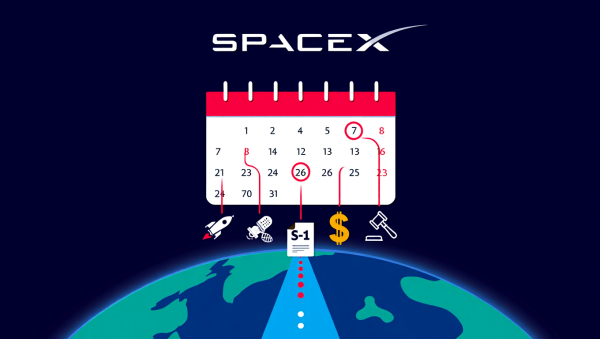
As SpaceX heads for what would be the largest initial public offering on record, a warning has emerged that changes to major stock index inclusion rules could create a structure unfavourable to retail investors.
Electrification outlet CleanTechnica reported on June 7 that, ahead of SpaceX’s listing, lower hurdles for inclusion in the Nasdaq 100, Russell U.S. stock indexes and the FTSE Global Equity Index Series have raised the possibility of large passive inflows.
The central issue is that if SpaceX is quickly added to major indexes soon after listing, ETFs and pension funds that track those indexes could be effectively required to buy the stock.
Shawn Williams (숀 윌리엄스) of The Motley Fool pointed to Nasdaq changing its rules to bring forward the timing when SpaceX could be eligible for inclusion in the Nasdaq 100. “The bigger problem for ordinary investors is not historical precedent, but the structural changes and procedures the major indexes have cleared to include SpaceX,” he said.
Nasdaq has applied a “Fast Entry” rule since May 1, cutting the Nasdaq 100 waiting period from about 3 months to 15 trading days and removing a minimum free-float share requirement. That effectively means SpaceX can also be added to the Russell U.S. stock indexes and the FTSE Global Equity Index Series 5 trading days after listing. Williams said fast entry could prompt passive funds to make purchases worth tens of billions of dollars.
The problem is the limited supply of shares available for trading. “Most of the tradable shares will be absorbed by passive funds that are required to buy,” he said. Even if the share price and market value jump in the short term after listing, he said the structure could ultimately leave retail investors supporting insiders’ exits.
An insider selling timetable is also cited as a variable. Unlike typical newly listed companies, SpaceX is reported to have been designed without a 180-day lock-up and to allow insider selling to become possible in stages starting 2 trading days after earnings announcements. Some expect the first sales window could come in August. Elon Musk has agreed to a 366-day restriction on selling. Williams said that if historical precedent, rule changes to speed index inclusion, low free float and an accelerated insider cash-out schedule combine, retail investors could bear the burden.
Whether SpaceX will be included in the S&P 500 is developing differently from other indexes. S&P rejected on June 4 easing requirements for a 12-month listing history and profitability. As a result, SpaceX cannot be included in the S&P 500 for at least 1 year and must also meet profitability requirements after that.
Corporate governance and financial performance are also factors heightening market concerns. Chris Armitage (크리스 아미티지) put SpaceX’s IPO price at $135 per share, its valuation at about $1.77 trillion and the amount to be raised at about $75 billion. He noted SpaceX earned a $791 million profit in 2024 but swung to a loss of about $4.9 billion in 2025 and posted a $4.3 billion loss in the first quarter of 2026.
Musk’s control is expected to remain in place after listing. Armitage said Musk would retain about 85 percent of voting rights while serving as chief executive and chairman. He also said that if SpaceX registers as a controlled company, it would not be subject to Nasdaq rules requiring a majority of the board to be independent directors.
Armitage said changes to index inclusion rules could also affect public funds. With Nasdaq changing its methodology, large market-cap companies such as SpaceX can be included in the Nasdaq 100 15 trading days after listing, and retirement accounts and ETFs that track the index would have to buy the shares, he said. Denmark’s pension fund AkademikerPension, however, refused to participate in the offering and valued SpaceX’s intrinsic worth at under $1 trillion.
The controversy surrounding the IPO is spreading beyond a major listing event into a case where index rule changes, passive inflows, insider cash-outs and governance issues are intertwined. Key market watch points are how quickly index inclusion occurs after listing, how much passive money flows in and how insider sales affect the share price.
 Yoonseo Lee
yslee@d-today.co.kr
Yoonseo Lee
yslee@d-today.co.kr