
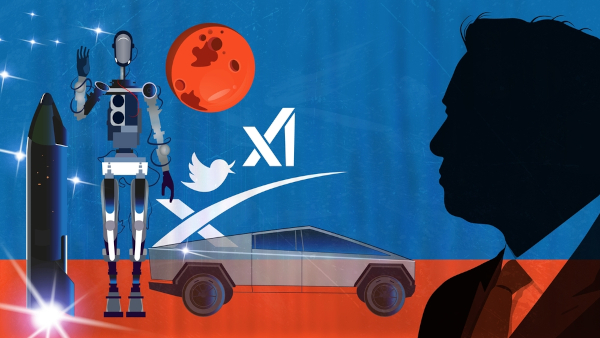
[Digital Today reporter Yoonseo Lee] Large funding needs and strong control that would remain after listing have been cited as reasons Elon Musk (일론 머스크) is moving ahead with a SpaceX initial public offering (IPO), despite his previously negative stance.
Cleantechnica, an electric-vehicle outlet, reported on June 7 local time that SpaceX’s cash burn is rising quickly, increasing the need for external financing. It also reported Musk would retain 85 percent of voting rights after a listing.
Musk has repeatedly warned about pressures from public markets. In 2023, he said of SpaceX, "We do not care at all about quarterly results and the stock price." He also said he did not think it was worth listing before there was a stable and predictable stream of profit. In an email to employees in 2013, he also showed a cautious stance, saying he did not want to list until a Mars transport system was in place.
SpaceX’s financial situation has deteriorated sharply in recent years. The company posted a profit of $791 million in 2024, but swung to a loss of about $4.9 billion in 2025. It recorded a loss of about $4.3 billion in the first quarter of 2026. Its accumulated deficit is about $41.0 billion. Revenue last year was $18.7 billion, up 33 percent from a year earlier, and first-quarter revenue this year rose to $4.7 billion from $4.1 billion, but profitability remains low.
A key backdrop to the IPO is a shift in the business structure. Starlink is generating profit, but other business divisions continue to consume large amounts of funding. Debt burdens have also been added after the company incorporated artificial intelligence (AI) startup xAI in 2026.
Another focus for the market is Musk’s control. Musk is expected to maintain 85 percent of voting rights after listing, setting up a structure that would effectively keep SpaceX under his sole control. There is also criticism that mechanisms for outside shareholders to intervene materially in management are limited.
Concerns about profitability persist. Starlink users are increasing, but average revenue per user fell to the mid-$60s in early 2026 from about $99 a month in 2023, according to figures compiled by Chris Barney (CFA). As a trend of lowering prices to expand users emerges, profitability pressure could increase further if competition from Amazon and Chinese satellite networks intensifies, the analysis said.
Musk has previously said that listing Tesla was inevitable for the company’s survival. This time, it is being highlighted that SpaceX has entered a phase where it needs to raise large amounts of funding in public markets to continue long-term projects. Still, it is unclear whether a listing would immediately ease the financial burden. Despite revenue growth, SpaceX is seeing large-scale investment and losses expand at the same time, and a Musk-centric governance structure is likely to remain even after listing.
As a result, the key points to watch in a SpaceX IPO narrow to two tracks. The focus is whether Starlink and heavy rocket development can translate into real cash-generating power, and whether investors will accept a structure of strong Musk control even after it becomes a public company.
 Yoonseo Lee
yslee@d-today.co.kr
Yoonseo Lee
yslee@d-today.co.kr