
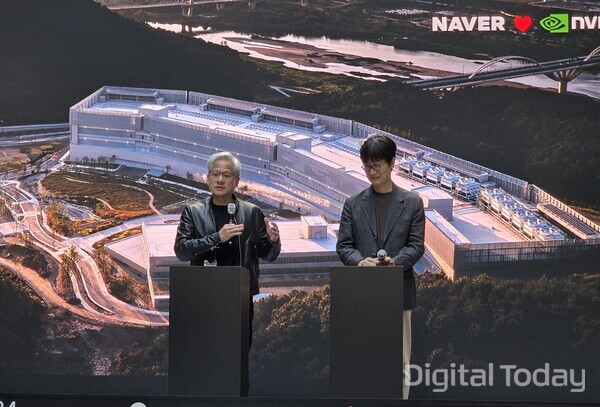
Nvidia CEO Jensen Huang (젠슨 황) named Naver a key partner for expanding artificial intelligence cloud services in South Korea and globally. Cooperation between Naver and Nvidia is expanding beyond GPU supply and technical partnerships to open AI model development, building large-scale AI cloud infrastructure and advancing robotics.
Huang said at a media scrum on June 8 at Naver’s 1784 headquarters in Seongnam, south of Seoul, that Naver is a company that developed world-class AI and cloud technology in South Korea. He said Naver was a partner that built an Nvidia GPU-based SuperPOD in Asia at an early stage, and the two have long studied AI technology together.
Huang said Nvidia is working with several South Korean companies, but cited Naver’s strengths as its cloud, software and AI capabilities. He described South Korea as a rare country that has manufacturing, heavy industry, electronics and software at the same time, and said much of its software and cloud capability comes from Naver.
Huang outlined three areas of cooperation with Naver. The first is developing open frontier AI models through the Nvidia Nemotron consortium. He said the two will build open frontier AI models together, adding that Naver could join the consortium as a partner because of the world-class expertise of Naver’s AI team.
The second is building AI cloud infrastructure. Huang called Naver South Korea’s leading cloud operator and said it is expanding overseas. He said the two are working together to build a 200-megawatt AI factory, describing 200 MW as an extremely large supercomputer and saying it is only the beginning and will expand to gigawatt scale. He said that once completed at gigawatt scale, Naver will become a company 10 times larger than it is now. Under a roadmap the two announced together, Naver will expand infrastructure in stages, starting operations of 55 MW in the first half of 2027 at its hyperscale data centre, GAK Sejong, in Sejong City, reaching 100 MW within that year and 200 MW by 2028.
The third is robotics. Huang said Naver has developed robot technology for more than 10 years and that he saw a robot delivering iced coffee during his visit to the headquarters. He said it felt dreamlike to see a robot roaming around like R2-D2 and delivering coffee, and described Naver as a “company of the future.”
In a question-and-answer session, Naver board chairman Lee Hae-jin (이해진) also explained directly why Naver can be Nvidia’s key partner. Lee said Naver was the world’s first company to build a SuperPOD and that it operates Asia’s largest services stably and has experience building and operating its own data centres.
Lee stressed Naver’s level of preparedness. He said Naver is not saying it will build cloud services and run an AI factory in the future, but is already ready. He said Naver is the only company that can meet demand in the GPU and AI market, where demand is rising sharply.
This shows Naver’s intention in this cooperation to position itself not as a simple buyer of GPUs but as an operator that can build and run AI infrastructure directly. That is because as AI competition expands from model performance to training and inference infrastructure, data centre operating efficiency and responding to sovereign AI demand by country, the importance of large-scale GPU clusters and cloud operating capability has increased.
Naver’s role in the Nemotron consortium is in the same context. Huang praised the achievements of frontier AI labs such as OpenAI and Anthropic, but said it is difficult for general-purpose AI alone to meet all demand by country, company and industry. He said strong open frontier models are needed to tune AI models to specific areas such as the Korean language and culture, science, digital biology, robotics and manufacturing. He said the reason for cooperating with Naver is that Naver builds AI very well, and stressed that consortium members such as Cursor and Mistral are all world-class AI builders.
According to what the two announced together, the cooperation also aligns with Naver’s sovereign AI strategy. Naver is fine-tuning Nvidia’s Nemotron open models with its own data and training capabilities to advance HyperCLOVA X. It is also pushing to develop the “Seoul world model” by combining Nvidia’s Cosmos world foundation model with Naver’s city street-view data and spatial modelling technology. The two also agreed on a direction to secure leadership of the AI infrastructure ecosystem beyond Asia-Pacific to markets in Europe and the Middle East.
Events held ahead of the scrum also continued to draw attention. Huang arrived at the 1784 headquarters at about 3:50 p.m. and was greeted by Lee. The two took part in a speech-bubble event using Naver Webtoon hit title “The Greatest Estate Developer.” Lee wrote, “Happiness is pork belly, work is perilla leaves. Wrap it up and eat it all at once,” and Huang wrote, “Don’t worry, I have GPUs.” Huang explained the meaning by saying the more GPUs you have, the more you can work and the happier you can be. After that, about 57,000 people joined Chzzk Live simultaneously.
A warm episode also emerged toward the end of the scrum. Huang referred to a pork belly dinner meeting during his visit to South Korea with Lee and other South Korean business leaders, saying Lee paid the entire restaurant’s dinner bill and drawing laughter as he said people should keep an eye on which restaurants Lee goes to. Lee responded that he would promise for life that he would always pay when eating pork belly with Huang in the future. Huang said he received a new name, “K. Jensen,” from Seoul National University students and said people should call him K. Jensen when he comes to South Korea.
 Lee Ho-jung
lhj@d-today.co.kr
Lee Ho-jung
lhj@d-today.co.kr