
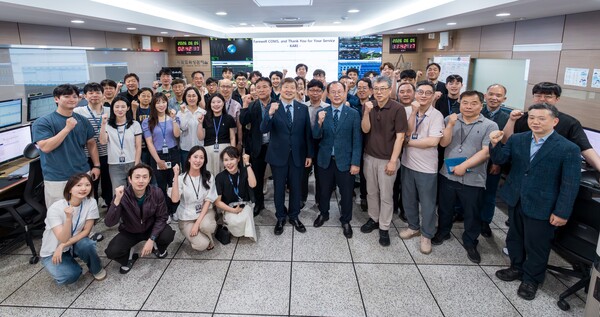
South Korea’s first geostationary satellite, Cheollian Satellite-1, has completed its 16-year mission and settled into a disposal orbit.
The Korea Aerospace Research Institute said it successfully completed the satellite’s disposal manoeuvres and component deactivation at 1:32 a.m. on June 8 and finally ended operations.
The disposal was carried out by cutting power to all onboard payloads and then moving it to a disposal orbit about 300 km higher than its previous geostationary orbit at an altitude of about 35,786 km, a so-called “graveyard orbit”. KARI raised the satellite’s altitude through six manoeuvres. After entering the disposal orbit, it vented all remaining fuel, deactivated the propulsion and power systems and then completely cut power.
Launched in June 2010, Cheollian Satellite-1 carried out weather and ocean observations and communications missions for 16 years, exceeding its original design life of 7 years. With Cheollian Satellite-1, South Korea became the world’s seventh country to own a meteorological observation satellite.
The meteorological payload took about 560,000 images over about 9 years and was used to observe disaster-related weather phenomena such as typhoons and heavy rainfall. The ocean payload also contributed to monitoring red tides in the West and South seas and tracking marine pollution through about 30,000 images. The communications payload provided the country’s first geostationary satellite communications test service.
Cheollian Satellite-1 flew a distance of about 1.6 billion km over 16 years. KARI reduced fuel consumption and achieved long-term operations by introducing an “inclined-orbit operations method” from April 2021 that reduced north-south station-keeping manoeuvres.
The disposal manoeuvre is an example of “active disposal”, in which the operating agency directly moved an end-of-life satellite to a disposal orbit instead of leaving it. An assessment says it shows that space development competitiveness includes not only the technology to launch and operate satellites, but also the capability to responsibly clear satellites after their service life ends.
Cheollian Satellite-1’s Earth observation missions were taken over by Cheollian Satellite-2A in meteorology and Cheollian Satellite-2B in ocean monitoring. Its orbital and frequency resources will be transferred to the follow-on satellite, Cheollian Satellite-3.
KARI President Sang-cheol Lee (이상철) said Cheollian Satellite-1 was the country’s first geostationary satellite and successfully carried out weather and ocean observations and communications missions over the past 16 years. By conducting active disposal to clear the orbit for follow-on satellites, he said, it will be a milestone proving the country’s capability to operate national satellites across their full life cycle.
 Jin-ho Lee
jhlee26@d-today.co.kr
Jin-ho Lee
jhlee26@d-today.co.kr