
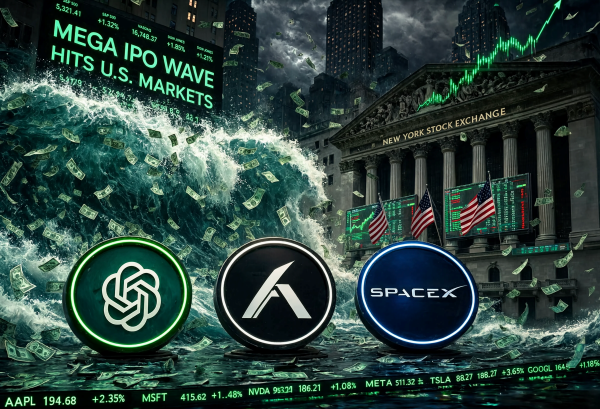
As SpaceX and Anthropic begin initial public offering procedures and OpenAI is seen as a possible follower, attention is turning to whether U.S. stock markets can absorb listings from very large private technology companies.
On June 8, online media outlet GigaZine reported that market attention is focused less on the mega IPOs themselves than on potential shifts in supply and demand as freely tradable shares are released after listing. If SpaceX, Anthropic and OpenAI all list, there are also projections that up to $4 trillion in market capitalisation could be newly added to U.S. stock markets.
SpaceX submitted an IPO registration statement to the U.S. Securities and Exchange Commission in mid-May. The expected fundraising amount is about $75 billion and its valuation is discussed at about $1.75 trillion. Anthropic also confidentially submitted a draft IPO registration statement to the SEC on June 1. The number of shares and the price have not been set, but its valuation was assessed at $965 billion based on a recent fundraising round. OpenAI is also seen as likely to submit an IPO registration statement soon.
If all three companies list, total fundraising could exceed $200 billion. SpaceX and Anthropic are each expected to raise more than $60 billion, and the issue for markets has become whether U.S. stock markets can digest large volumes of new shares in a short period.
Steve Sosnick (스티브 소스닉), chief strategist at Interactive Brokers, cited index inclusion as a key risk factor. If index providers quickly add these stocks to major benchmarks, funds and exchange-traded funds that track those indices would have to buy large amounts of newly listed shares soon after listing, he said.
Some analysis says the initial shock could be limited. The total market capitalisation of companies included in the Russell 3000 is about $79 trillion, and the S&P 500 is about $69 trillion. Even if SpaceX is included in the S&P 500, its initial weighting is estimated at about 0.1 percent. Even after the Nasdaq 100 changed its rules to allow weightings of up to three times the free float, its initial weighting is expected to remain around 0.5 percent.
The issue is what happens after that, rather than immediately after listing. Under lock-up provisions, insiders and early investors cannot immediately sell existing shares at the time of an IPO. But once restrictions are lifted, large amounts of shares could enter the market in sequence. The larger the company, the bigger the impact on market supply and demand is likely to be.
For SpaceX, the timetable for share supply is discussed in relatively concrete terms. If $75 billion of shares are issued and its valuation reaches $1.75 trillion, the initial free float ratio is about 4 percent. About half of Elon Musk’s stake cannot be sold for 366 days after the IPO. The remaining shares, which amount to less than half of the market capitalisation, come out of lock-up earlier. After the first quarterly earnings release, insiders can sell 20 percent of their holdings, and they can sell an additional 10 percent if the stock price rises more than 30 percent above the offering price.
There is also caution about post-listing returns. According to an analysis by Jay Ritter of the University of Florida, the three-year return of companies that listed from 1980 to 2024 was 20 percentage points lower than the market average. For companies valued at more than 40 times sales, the underperformance was larger at 58 percent. Based on a $1.75 trillion valuation, SpaceX’s valuation exceeds 90 times sales. This means that even if investment fever grows, valuation 부담 could increase over the long term.
In particular, if large private companies representing the artificial intelligence and space industries move to public markets at the same time, index inclusion and passive inflows could initially support share prices. But if insiders and early investors begin selling in earnest after lock-ups expire, concerns are being raised that the market could again face supply-and-demand pressure.
The key in this case is not the scale of listings by very large AI and space companies itself, but the impact on the market from index inclusion and lock-up expiries after listing. The process of larger private technology companies moving into public markets is expected to test the absorptive capacity of U.S. stock markets.
 Yoonseo Lee
yslee@d-today.co.kr
Yoonseo Lee
yslee@d-today.co.kr