
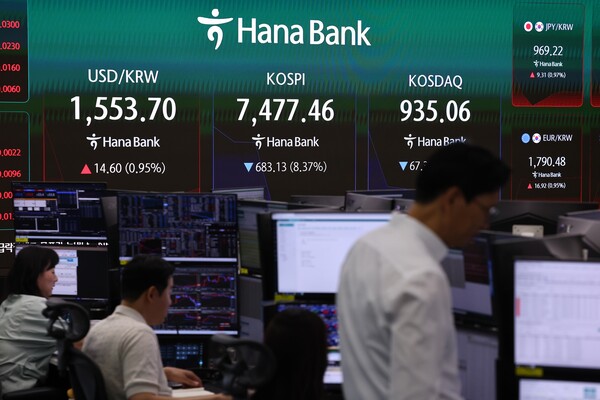
[Digital Today reporter Oh Sang-yup (오상엽)] South Korean stocks plunged on June 8 in what was described as “Black Monday.” The slide extended as a U.S. market drop and weakness in semiconductor shares weighed. Sell-side sidecars were triggered on the KOSPI and Kosdaq, followed by circuit breakers.
The Korea Exchange disclosed that it triggered a first-stage circuit breaker on the Kosdaq at 2:36:52 p.m. after the index fell more than 8 percent from the previous close.
The disclosure said the Kosdaq stood at 921.85 points, down 80.59 points, or 8.03 percent, from the previous close of 1,002.44. Trading on the Kosdaq market was halted for 20 minutes after the index stayed down more than 8 percent for 1 minute.
A circuit breaker is a system that temporarily halts trading in the stock market and related derivatives markets to ease shocks when stock indexes plunge.
A first-stage circuit breaker is triggered if an index stays down at least 8 percent from the previous day for 1 minute or more. When the first stage is triggered, trading in the stock market and related derivatives markets is suspended for 20 minutes.
As of 2:41 p.m., the Kosdaq was at 921.88, down 80.56 points, or 8.04 percent, from the previous session. The index opened at 959.61 and fell as low as 921.78 during the session, widening losses.
The main board also fell sharply. Early in the session, circuit breakers and a sell-side sidecar were triggered on the KOSPI. A sidecar is a system that suspends the effectiveness of programme trading quotes for 5 minutes to ease the impact on the spot market when futures prices move sharply.
On the main board, a sell-side sidecar is triggered when the KOSPI 200 futures price stays down at least 5 percent from the reference price for 1 minute or more.
On the Kosdaq, a sell-side sidecar is triggered when the Kosdaq 150 futures price falls at least 6 percent from the reference price and the Kosdaq 150 index falls at least 3 percent for 1 minute.
The market slump was seen as driven by the shock from a U.S. selloff and weakness in major domestic semiconductor shares. The recent plunge in semiconductor stocks in the U.S. market carried into South Korea, and pressure to take profits also grew after the KOSPI recently showed a record-high trend.
In particular, the KOSPI faced heavier downward pressure as major semiconductor shares such as Samsung Electronics and SK Hynix wavered. Losses were larger on the Kosdaq as selling spread across growth stocks and small- and mid-cap shares.
The risk-off mood across the market appeared to strengthen as the Kosdaq also plunged after a correction led by KOSPI large caps.
The Korea Exchange held an emergency market inspection meeting earlier in the day to review conditions in response to rising volatility in domestic and overseas markets. It said it would closely monitor global stock markets, the situation in the Middle East and the exchange rate in cooperation with financial authorities, and implement market-stabilisation measures such as sidecars in a timely manner.
 Oh Sang-yup
yub@d-today.co.kr
Oh Sang-yup
yub@d-today.co.kr