
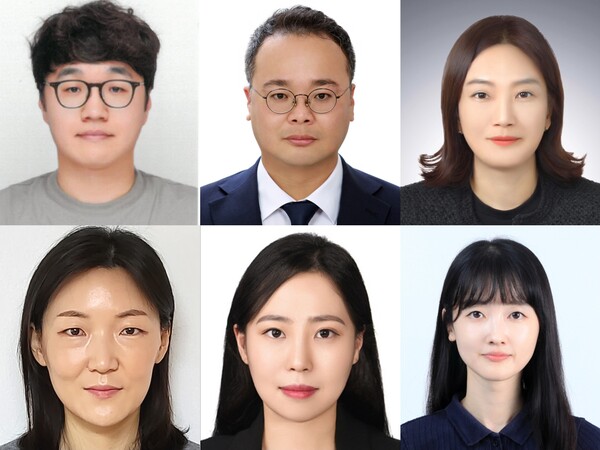
South Korea's Ministry of Science and ICT and the Korea Industrial Technology Association selected 6 people as June 2026 winners of the Korea Engineer Award, they said on Sunday.
Sang-ho Han (한상호), a principal engineer at HD Korea Shipbuilding & Offshore Engineering, was chosen in the large company category. Jae-ung Bang (방재웅), CEO of Raum Architects, was selected in the small and midsized company category. The women's category winners were Suk-young Noh (노숙영), a master at Samsung Electronics, Su-hee Shin (신수희), a team leader at LG Electronics, and Areum Jung (정아름), a principal at Hanwha Ocean. Seo-yeon Park (박서연), CEO of Caramela, was selected in the young category.
The award is a prize system that selects engineers who contributed significantly to technology sites and gives a deputy prime minister's award and 5 million won in prize money. It has been operated since 2002 with the ministry's Science and Technology Promotion Fund and lottery funds.
Han was recognised for developing a ship air lubrication system that achieved a 7 percent fuel-saving effect in actual operations, and a liquefied petroleum gas (LPG) cargo management system that can cut power use for cargo management by up to 20 percent. The LPG cargo management system was recognised for reducing ship operating costs by about $100,000 a year and carbon dioxide (CO2) emissions by 200 tonnes a year, achieving a 40 percent global market share in 2024.
Bang was recognised for developing and applying a cloud- and sensor-based artificial intelligence (AI) smart construction supervision system at construction sites that had relied on visual checks and drawings. The system improved process efficiency by 30 percent and reduced the quality error rate by 20 percent, and has been introduced at 54 sites so far.
Noh developed a colour separation structure technology that controls light paths with a metasurface, overcoming the light-loss limitations of existing image sensors and improving light sensitivity in low-light environments by 25 percent. The technology was first applied in the world to a commercial smartphone in 2025.
Shin was recognised for developing materials used in producing home appliances such as washing machines and refrigerators, or improving their functions, to secure productivity and environmental friendliness. By developing a new stainless steel material that can be laser-welded, Shin improved washing machine productivity by 200 percent. Shin also developed an ABS plastic material that delivers a matte effect without additional surface treatment.
Jung was recognised for developing an "automated loop system" that enables automation of power and communications cable installation work in a ship engine room. The system raised the mechanisation rate for LNG carriers to 42.2 percent from 18.4 percent and lowered the rating of perceived exertion (RPE) index by 5 levels.
Park was recognised for leading the development of customised AI solutions for the public and industrial sectors, including commercialising an AI digital sex crime detection system and conducting demonstrations of an AI solar power generation forecasting system. Results from applying the AI solar power generation forecasting system at corporate sites achieved a 15 percent annual reduction in maintenance costs, a 20 percent improvement in operational efficiency and a 40 percent reduction in data processing time.
The ministry plans to expand the scope of awards by launching categories for start-ups using public research outcomes, master's and doctoral degree holders and engineers at research institutions from the second half of this year.
 Seulgi Son
sageson@d-today.co.kr
Seulgi Son
sageson@d-today.co.kr