
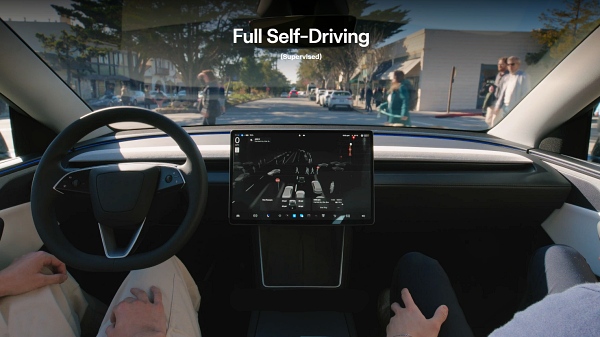
[DigitalToday intern reporter Seung-a Yoo] An assessment said Tesla's competitiveness is more clearly seen in the user experience created by software updates and its charging network than in self-driving functions.
IT outlet ITMedia reported on June 7 that Tesla continues to differentiate itself by continuously improving vehicles like digital devices and reducing everyday inconveniences.
The key is change that users feel every day, rather than flashy new features. Examples include the in-car experience provided by a large display, feature improvements via over-the-air software updates, and the simple charging procedure at its own fast-charging network, the Supercharger. The approach of improving the overall process through software, rather than the vehicle's performance itself, is seen as a strength.
A representative example is Dog Mode. The feature began when a Tesla owner asked Elon Musk (일론 머스크) on social media to display a message on the screen saying, "It's OK. The owner will be back soon and the air conditioning is on," while keeping music and the air conditioner running in the car. Musk replied "Yes" within minutes, and the function was added months later through an actual software update.
Dog Mode later evolved further. A function was added that lets users check the car's interior in real time video from a smartphone lock screen while the feature is running. The report described it as a feature that has taken hold by reducing drivers' anxiety when leaving a pet in the vehicle briefly.
Such changes are cited as examples showing the value of software-defined vehicles. One automotive journalist questioned the impact of adopting SDVs and described Tesla's OTA updates as "about a reduction in wiper malfunctions." But from users' standpoint, such changes are not small. Improvements such as better wiper performance or features like Dog Mode may seem minor, but they reduce repeated inconveniences and raise perceived satisfaction.
That is described as Tesla's true competitive edge. From users' standpoint, improvements that reduce small stresses are the car's evolution, and the value of SDVs also lies there. It means satisfaction depends on how quickly frequently used features are improved, rather than on competition in advanced technology.
The charging experience is also evaluated in the same context. At Superchargers, credit card information is linked to the vehicle, so charging starts automatically once users plug in the charger. During charging, remaining time and power output information are displayed in real time.
The navigation system's Trip Advisor function calculates the charge needed and distance to the destination and guides users to the optimal charging time. Notifications are also sent through a dedicated app before charging ends and right after it finishes. By contrast, if a vehicle remains parked after charging is complete, a penalty of up to 100 yen per minute, or about 965 won, is imposed depending on conditions. It is a structure designed to manage both charging convenience and turnover.
Ultimately, Tesla's strength is not only in self-driving or an image of future technology. It lies in continuously improving functions through software updates and reducing repeated inconveniences by connecting the process seamlessly through charging. Tesla continues to compete on user experience that makes people see cars not as simple machines but as products closer to a digital service.
 Seung-a Yoo
ysah@d-today.co.kr
Seung-a Yoo
ysah@d-today.co.kr