
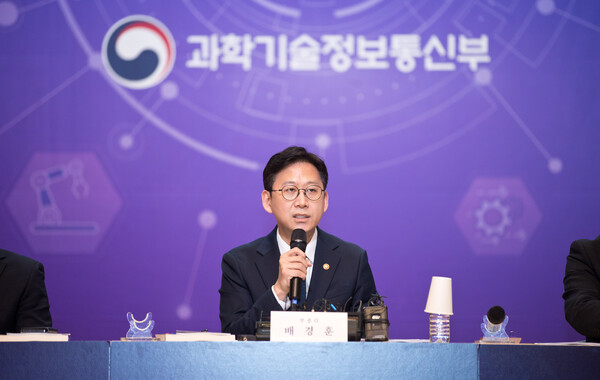
[Digital Today reporter Lee Jin-ho] "Kyunghun-nim is really called more widely than the deputy prime minister. These days, calling him deputy prime minister even feels awkward. Of course, Kyunghun-nim also calls us by our names." (MSIT Secretary A)
A horizontal work culture is taking root inside the Ministry of Science and ICT. Organisational culture changes started by Deputy Prime Minister and Minister Bae Kyung-hoon appear to be spreading beyond changes in forms of address to reporting methods and overall communication among employees.
After Bae took office last year, the ministry introduced a culture of omitting ranks and adding "-nim" after a person’s name. It is an unusual attempt in the civil service, where hierarchy is strong. MSIT officials commonly relay that Bae, from right after taking office, stressed a 분위기 in which freer expression of views is possible rather than using authoritative honorifics within the ministry.
It felt awkward at first, but as time passed this naming culture took hold naturally. It has also become natural for Bae to be called "Kyunghun-nim" at the ministry. Bae also addresses MSIT officials by adding "-nim" to their names instead of using ranks.
The change also connects with Bae’s background. Bae, born in 1976, is a former private-sector businessman who served as head of LG AI Research. He brought to MSIT an approach he used in leading a company that reduced formalities and emphasised efficiency.
Vice ministers are no exception. First Vice Minister Koo Hyuk-chae (구혁채) is called "Jarong-nim" and Second Vice Minister Ryu Je-myung (류제명) is called "Soljeong-nim." Koo’s nickname is said to have been taken from Zhao Zilong, a famed general from Romance of the Three Kingdoms. Soljeong, attached to Ryu, is a nickname combining the characters meaning "to take the lead" and "upright."
This horizontal naming culture is spreading beyond the ministry to external briefings and meetings. When meeting private-sector experts and researchers at policy sites, Bae places weight on creating an atmosphere for free discussion rather than on formal titles.
A representative example is the Science and Artificial Intelligence (AI) Future Strategy Meeting. Bae is known to have directly proposed to participants that they address one another with "-nim" rather than by position. The aim is to set aside titles and exchange views as equal discussion partners in a forum with private experts and researchers.
These changes at MSIT are also tied to improvements in work practices. It makes meeting materials as concise as possible and, where possible, moves Monday morning meetings to the afternoon. This is to reduce the practice of employees giving up weekends to prepare for Monday mornings.
MSIT is also pursuing efforts to spread praise and encouragement as part of its organisational culture. Since February, it has operated a "praise domino" programme that selects employees who show outstanding work attitudes and a strong sense of responsibility. "Praise will take root as an everyday organisational culture so that voluntary collaboration and proactive work attitudes can naturally follow," Bae said, adding, "We will continue to spread an organisational culture in which respect and collaboration are alive, using praise as a medium."
Bae will mark the first anniversary of his inauguration on July 17. As the first science and technology deputy prime minister under the Lee Jae-myung government, Bae is simultaneously pushing major tasks including becoming one of the world’s top three AI powers, restructuring the national research and development system, securing advanced strategic technologies and cybersecurity.
An MSIT official said, "An organisation does not change overnight just because the form of address changes, but it is at least becoming an opportunity to change how we treat one another and work efficiency." The official added, "It seems important to keep creating an atmosphere where employees can freely express opinions and work with a sense of responsibility."
 Lee Jin-ho
jhlee26@d-today.co.kr
Lee Jin-ho
jhlee26@d-today.co.kr