
South Korea's Broadcast Media Telecommunications Commission is moving in earnest to build an advertising-supported free streaming TV (FAST) ecosystem.
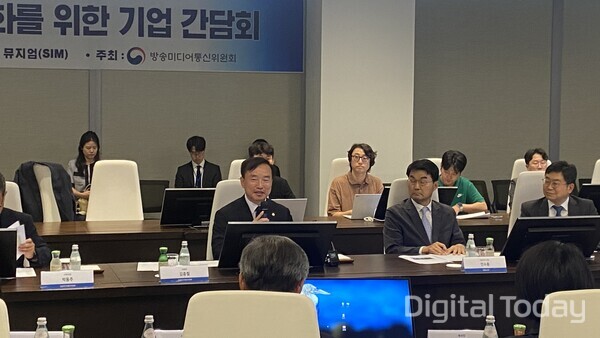
Kim Jong-cheol (김종철), chairman of the commission, said at a corporate meeting on strengthening K-FAST competitiveness held on June 4 at Samsung Electronics' Innovation Museum in Suwon that the broadcasting and media industry must make global distribution platforms such as FAST part of its strategy to find a way forward as it struggles with falling advertising revenue.
The meeting was attended by 25 people including Kim, FAST platform operators Samsung Electronics and LG Electronics, 5 channel operators including New ID, Smart Media Lab, K2NT and CJ ENM, 9 broadcasters including KBS, MBC and SBS, content producer AStory, and AI technology firms Hudson AI and ESTsoft. It was the first meeting on FAST since the commission was launched.
FAST is a streaming model that lets users watch content for free in exchange for viewing advertisements. It is growing rapidly, mainly in North America. The global market is forecast to grow to 47 trillion won in 2030 from 18 trillion won in 2025. The compound annual growth rate is 20.9 percent.
Samsung Electronics is South Korea's largest FAST platform operator. Samsung TV Plus has surpassed 100 million monthly active users across 30 countries worldwide. It provides 4,300 channels and about 66,000 VOD titles for free. LG Electronics is also supplying more than 110 channels at home and abroad through LG Channels.
Kim said South Korea has both an installed base of 600 million smart TVs distributed worldwide and world-class capabilities in producing broadcast content. He stressed that it is important to connect them effectively and create an environment in which domestic media and content can spread more widely to global viewers.
The meeting began with a demonstration of Samsung Electronics' FAST service. Samsung Electronics President Lee Won-jin presented the company's operating strategy for its FAST business and discussed Samsung's role in building the K-FAST ecosystem. Samsung Electronics and New ID then introduced the status and strategies for operating global platforms and channels, and AI technology firm Hudson AI presented cases of localising broadcast content using AI.
Participants assessed that global growth could be a new opportunity for domestic broadcasters and producers. At the same time, they pointed to the low ratings for Korean content in the global FAST market, citing that it remains at the level of simply rerunning past content. They also said a strategic approach is needed to plan and schedule content by analysing the preferences and demand of North American viewers. They discussed the need to plan customised content linked to advertising based on viewing data and for the government and platform companies to invest to produce content dedicated to K-FAST.
"Not something ministries should fight over"... Commission seeks role in broadcast content and advertising
The commission said it will cooperate with relevant ministries from the perspective of building a FAST ecosystem.
FAST currently has no legally responsible ministry, like OTT. FAST content falls under the Ministry of Culture, Sports and Tourism, and platforms under the Ministry of Science and ICT, but there is no legal definition in place for advertising and other areas. The commission is seeking a role, as the ministry in charge of promoting broadcast advertising and broadcast content, without clashing with the Ministry of Science and ICT and the Ministry of Culture, Sports and Tourism.
It is particularly focused on helping domestic media operators develop overseas sales channels. FAST is growing rapidly in North America, where pay-TV fees are high, as an alternative to cord-cutting, but in South Korea it is difficult to activate because IPTV fees are low.
Building advertising infrastructure is also a task. In South Korea, broadcast advertising is handled by the Korea Broadcast Advertising Corp (KOBACO) for terrestrial and small and medium-sized broadcasters, but there is no such media lab for FAST. Even if content is supplied to North American channels, a revenue structure cannot be created unless it is connected to local advertisers. Unlike existing broadcast advertising, which is linear advertising based on scheduling time slots, FAST can also enable a new, technology-based advertising model that links featured actors or locations to commerce.
A commission official said it is right that FAST platforms fall under the Ministry of Science and ICT as online video services. The official added that building an ecosystem cannot be done by platform operators alone and must be done together with the commission, which is responsible for promoting content and advertising. The official said domestic broadcasters and content producers have no answer in relying only on the domestic market, and added that a better ecosystem than now would be created if the Ministry of Science and ICT finds a role through AI localisation technology and the commission finds a role in content and advertising.
 Seulgi Son
sageson@d-today.co.kr
Seulgi Son
sageson@d-today.co.kr