
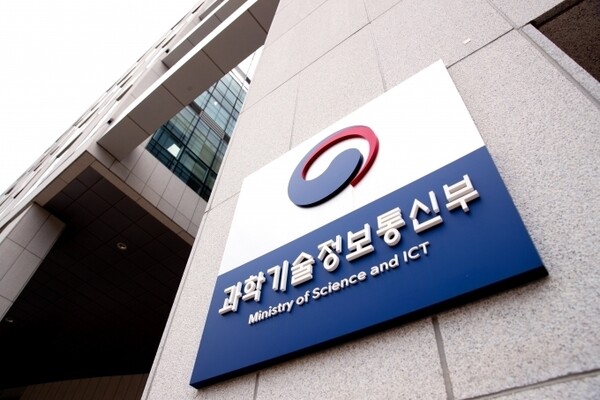
South Korea's Ministry of Science and ICT is pushing ahead with a new research and development program to innovate science and technology research methods using artificial intelligence (AI).
The ministry on Wednesday held a project kick-off briefing for the AI+Science and Technology (S&T) innovation technology development program. The program is being launched this year to promote AI-based research innovation in 6 key fields: bio, materials and chemistry, earth science, nuclear fusion, nuclear power and secondary batteries.
The ministry selected 6 projects after considering research and industrial ripple effects and demand from research sites. It will invest a total of 22.5 billion won over 4 years from 2026 to 2029.
Science and technology research has relied on researchers' experience and intuition, repeated experiments and trial and error, which has taken a lot of time and cost. With recent advances in AI technology making it possible to analyse massive scientific data and predict complex phenomena, new research methods are drawing attention for boosting research productivity and accelerating scientific discovery.
Researchers in each field and AI and data specialists will participate together in the selected projects. The ministry will support computing infrastructure, including graphics processing units (GPUs), needed to develop AI models. Research data and AI models secured through the program will be opened through a public platform.
In the bio field, a team led by Dong-gwan Shin (신동관) at the National Cancer Center will develop AI that predicts drug response transfer among cell lines, organoids and animals using multiscale drug response omics big data. In materials and chemistry, a team led by Changyun Sohn (손창윤) at Seoul National University will develop an AI model that can predict composite properties of future polymer and electronic materials or design new materials optimised for target performance.
In earth science, a team led by Seung-ki Min (민승기) at Pohang University of Science and Technology will develop an AI model specialised for the Korean peninsula based on an integrated climate and disaster data platform. In nuclear fusion, a team led by Eunmi Choi (최은미) at Ulsan National Institute of Science and Technology will develop AI-based heating and current drive device digital twin technology and synthetic diagnostics technology to predict in real time the heating process and state of plasma in a fusion reactor.
In nuclear power, a team led by Seungjun Lee (이승준) at Ulsan National Institute of Science and Technology will develop an AI-based dynamic risk assessment agent platform that automates the safety assessment process for nuclear power plants. In secondary batteries, a team led by Jung-il Choi (최정일) at Yonsei University will build an AI platform that supports everything from materials design to performance and safety prediction by integrating and analysing data across multiple scales, including materials, electrodes and battery cells.
Kyungsook Yoon (윤경숙), director general for basic and fundamental research policy at the ministry, said the AI models and data developed in the 6 key fields are expected to serve as a priming role for the K-Moonshot Project. She said the ministry will actively support the use of AI at research sites to accelerate scientific discovery and innovation.
 Jin-ho Lee
jhlee26@d-today.co.kr
Jin-ho Lee
jhlee26@d-today.co.kr