
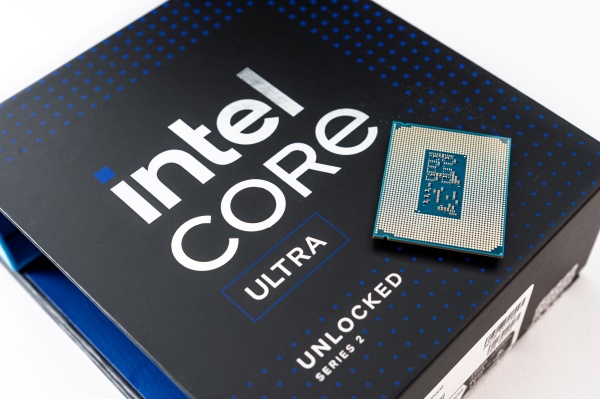
Intel's next-generation laptop processors are said to be facing supply shortages from the start of their launch. The products are also drawing attention because they are the first major lineup that Intel is producing itself using its most advanced 18A process, putting its strategy to restore manufacturing competitiveness in the spotlight.
Gigazine reported on June 3 that supplies of Intel's new mobile processors, the Core Ultra Series 3 (Panther Lake) and the Core Series 3 (Wildcat Lake), are not smooth.
Panther Lake was unveiled in January and Wildcat Lake in April, and both use Intel's next-generation 18A process. Intel has introduced them as key products symbolising its design and manufacturing capabilities and has presented them as a signal of a revival in manufacturing technology.
But the industry has pointed to supply conditions falling short of expectations. Technology journalist Tim Culpan said he heard about shortages of Panther Lake and Wildcat Lake from officials at three major PC makers. Some small and mid-sized PC makers are also said to be checking whether they can secure processors before taking customer orders. This suggests Intel is not supplying enough volume relative to market demand.
Intel also acknowledged that some supply problems exist. Alex Katouzian (알렉스 카투지안), general manager of Intel's Physical AI division, said on June 2 in response to questions that "there is a certain level of supply shortage, but we are overcoming it." He did not deny disruptions while saying the situation is gradually improving.
The supply issue is also tied to Intel's production strategy. Rival AMD and Nvidia use a fabless model focused on chip design and outsource manufacturing to TSMC. Intel, by contrast, has promoted its IDM model, in which it handles both design and manufacturing in-house, as a strength.
But as Intel has struggled in recent years to develop advanced process technologies, it has relied on TSMC to make some products. Major mobile processors such as Meteor Lake launched in 2023 and Luna Lake and Arrow Lake in 2024 also used TSMC production lines for a significant portion.
As a result, Panther Lake and Wildcat Lake were seen as symbolic products showing Intel's return to in-house manufacturing. The industry believes the supply shortage controversy will be the first test to verify yields and production stability of Intel's 18A process.
Some analysis says the cause of the supply problems may not lie only with Intel's fabs. Culpan pointed out that some I/O chips included in the processors are being made at TSMC. This raises the possibility that the disruption is linked not only to Intel's internal production capacity but also to supply chain management with partners.
Intel is also accelerating efforts to expand its foundry business for external customers. In April, it announced it had joined the AI chip project Terafab led by Tesla CEO Elon Musk and signed a contract to produce next-generation 14A process-based AI chips.
The industry sees whether Intel can reliably expand supplies of its latest processors as an important yardstick for the credibility of its foundry expansion and manufacturing competitiveness recovery strategy.
Intel’s 18A was supposed to be its comeback node. But it can’t get enough chips to PC makers. ⏬ pic.twitter.com/jHjyW2YlZ3
 Jinju Hong
hongjj@d-today.co.kr
Jinju Hong
hongjj@d-today.co.kr