
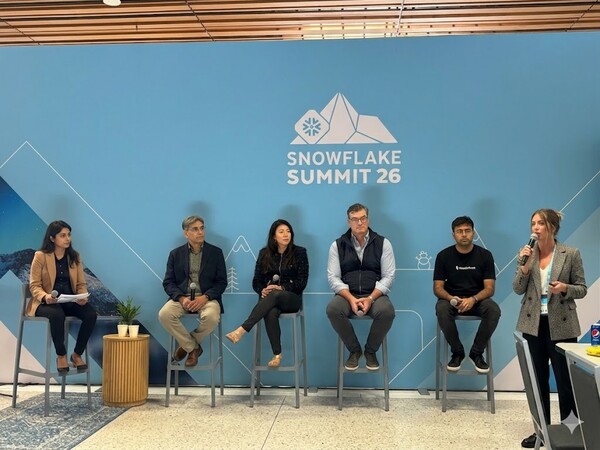
[San Francisco, United States=DigitalToday reporter Chi-gyu Hwang] Snowflake unveiled a range of new security products at its annual Snowflake Summit 26 conference, being held from June 1 to 4 local time.
At the event, Snowflake showcased a range of features under the theme of a security model for the agentic era. It focused on implementing zero-trust security for AI agents.
Snowflake first introduced an agent identity management (Agent Identity) feature.
According to the company, agent identity management applies role-based permissions before an agent accesses corporate data or takes action. It also enables a complete audit trail for all agent activity. This helps prevent rogue agent actions.
Snowflake also released an AI security posture management (AI Security Posture Management) solution.
It continuously monitors the security posture of AI systems, allowing faster investigation of violations. It also supports faster responses to risk through AI-based situational awareness support.
Snowflake also unveiled ransomware and data exfiltration prevention features. The features apply consistent security policies across all AI workloads, helping reduce ransomware and data exfiltration threats.
Snowflake also released a prompt injection prevention (Prompt Injection Protection) feature. The company said it helps protect enterprise AI without slowing the pace of AI innovation by blocking jailbreak attempts and zero-day vulnerabilities.
Through the announcements, Snowflake summarised its security strategy around three pillars: secure guardrails, centralised governance and data and AI protection.
Secure guardrails (Secure Guardrails) support prompt injection blocking and agent action security using AI signals and built-in defence features.
Centralised governance (Centralized Governance) enables overall security posture and perimeter management from a single control panel. Data and AI protection (Data and AI Protection) supports ransomware blocking and data exfiltration prevention through automated policies.
In a security and governance panel session held for the media, Snowflake assessed that agentic AI is fundamentally changing corporate security environments and stressed an integrated, platform-level response strategy. It also said, "Security is getting closer to the data," and highlighted that there will be more work to do in the AI security market going forward.
Snowflake said, "The future of security is not defined by more tools, and it is becoming more important to have visibility into data and AI systems and respond immediately." It added, "External security solutions are strong at 'detecting' threats, but actually viewing, controlling and taking immediate action on data is only possible where the data is."
Snowflake Chief Security Officer (CSO) Mayank Upadhyay (마얀크 우파댜이) said, "Agentic AI security is fundamentally different from existing security models." He said, "3 to 4 years ago, software had a predictable order of API calls, but agents, once given only a goal, explore paths on their own and inherit user permissions as they are." He added, "Agents are like giving an intern a credit card," drawing attention by comparing it to asking them to buy shoes but having them buy a car instead.
He said unpredictable risks arise, such as an agent reading data from one tool and leaking it to another, or halting production services. He said, "Identity and permission management are the key security challenges in the agentic era," and added, "The principle of least privilege is essential."
 Chi-gyu Hwang
delight@d-today.co.kr
Chi-gyu Hwang
delight@d-today.co.kr