
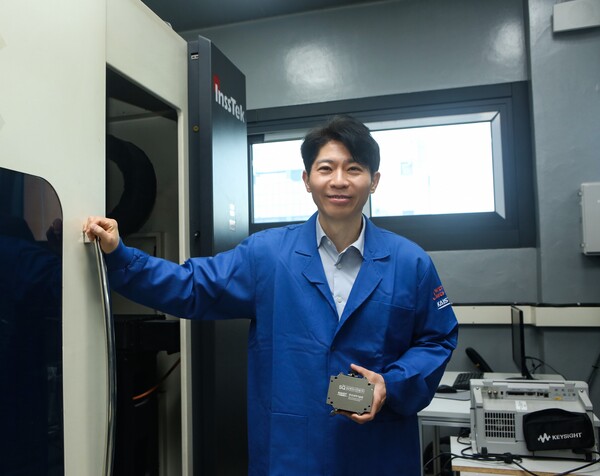
Son Hoon (손훈), a KAIST professor who developed sensor technology that can detect the movement of medium and small social infrastructure facilities in real time, has been selected as this month’s winner of South Korea’s Science and Technology Award.
The Ministry of Science and ICT and the National Research Foundation said on Tuesday they selected Son, a professor in KAIST’s Department of Civil and Environmental Engineering, as the June winner of the award.
Son was recognized for contributing to strengthening safety in the nation’s construction infrastructure by developing an affordable, high-precision displacement sensor technology for real-time disaster warnings for medium and small social infrastructure facilities.
As social infrastructure such as bridges and buildings ages, the importance of structural health monitoring is growing. Medium and small structures, which account for more than 98 percent of facilities worldwide, require precise observation because their displacement is as small as the millimeter level. Existing equipment costs at least 40 million won, limiting management, the ministry explained.
Son developed a simultaneous multi-physical measurement technology that uses a single sensor to measure acceleration, tilt and displacement at the same time. It fuses millimeter-wave radar with a MEMS (Micro Electro Mechanical System) accelerometer and applies a signal-processing algorithm. Millimeter-wave radar makes it easy to measure structural displacement that moves slowly. A MEMS accelerometer has the advantage of capturing fast vibrations well.
The sensor developed by Son costs less than 1 million won, or about one-fortieth of existing production costs, while securing both economic viability and accuracy with ultra-high precision of about 0.026 mm. It also reduced power consumption to 131 mWh, about one-hundredth of the previous level.
It also incorporates energy-harvesting technology that converts discarded energy in daily life into electrical energy and stores it. The sensor includes edge-computing functions, allowing it to judge collapse risk on its own without additional equipment and transmit alerts in real time.
The technology has been verified for reliability through on-site demonstrations at 13 or more sites at home and abroad. They include a parking structure at Stanford University, an expressway in San Jose, a bridge in Weifang, China, and the Geumgang Pedestrian Bridge in Sejong City.
The achievement is a case in which foundational technology developed with support from the ministry’s Basic Research Program, including Leader Research and Basic Research Lab funding, progressed through commercialisation and technology transfer. It was published in the international journal Mechanical Systems and Signal Processing in January 2023.
Son said, "This research is meaningful in that it has laid the technological foundation for precisely managing medium and small facilities that were left out of constant observation." He added, "Going forward, I will continue research on artificial intelligence-based digital twins to lead a paradigm shift in the safety diagnosis market toward automation, unmanned operation and intelligence."
 Jin-ho Lee
jhlee26@d-today.co.kr
Jin-ho Lee
jhlee26@d-today.co.kr