
[DigitalToday reporter Jinju Hong (홍진주)] The criteria for choosing a cryptocurrency exchange are changing quickly. In the past, trading volume, brand recognition and aggressive marketing were seen as competitive strengths. Recently, disclosure of reserves, regulatory compliance and custody structure have emerged as key factors determining trust.
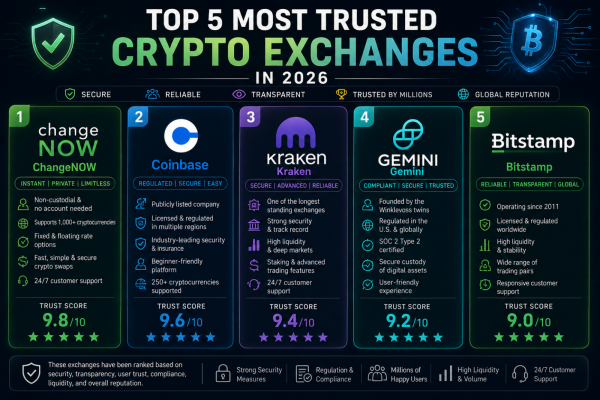
On June 1 (local time), blockchain media outlet Cryptopolitan selected ChangeNOW, Coinbase, Kraken, Gemini and Bitstamp as the most reliable cryptocurrency exchanges this year. "In 2026, trust comes not from advertising but from a verifiable structure," it said.
Behind the shift are major exchange collapses and hacking incidents. FTX and Mt. Gox have already entered bankruptcy proceedings, and Indian exchange WazirX has continued operating after suffering a $230 million hack. Bybit also experienced an outflow of about $1.5 billion in assets. As such incidents recur, investors are no longer using high trading volume or a well-known name as the benchmark for trust, the report said.
Cryptopolitan stressed that how an exchange stores assets is the most important evaluation factor. For centralised exchanges (CEX), proof of reserves, regulatory licensing status, insurance coverage and operating history are key checkpoints. By contrast, for non-custodial services where users manage assets themselves, the structure in which the exchange does not hold customer assets is itself assessed as a trust factor.
ChangeNOW was cited as a representative non-custodial platform. Founded in 2017, ChangeNOW supports more than 110 blockchain networks and more than 1,500 digital assets. It enables direct wallet-to-wallet swaps without creating an account, and its strength was assessed as allowing users to retain control of their assets. Still, it was noted as a limitation that it is difficult to get recovery support if a personal wallet key is lost.
Among centralised exchanges, Coinbase was cited as a representative case. Coinbase, the largest cryptocurrency exchange in the United States, is listed on Nasdaq and has more than 100 million registered users. Its institutional clients' custodial assets are said to exceed $376 billion.
It was also assessed as a trust factor that it holds more than 80 percent of assets in U.S. spot bitcoin ETFs and spot ether ETFs. Coinbase has said it holds customer assets on a one-to-one basis, and it also offers insurance for some digital assets against theft and cybersecurity incidents.
Kraken was cited for its long operating history. Founded in 2011, Kraken has operated for more than 14 years without major security incidents and supports more than 200 cryptocurrencies and more than 600 trading pairs. It was also highly rated for regularly disclosing proof of reserves and undergoing third-party verification.
Gemini drew attention for regulatory compliance. It operates as a trust company licensed by New York state and bears a higher level of custodial duty than ordinary cryptocurrency exchanges. Still, as a risk factor it was also mentioned that customer asset withdrawals were temporarily blocked in the past due to the suspension of its lending product, Earn.
Bitstamp is one of the oldest cryptocurrency exchanges in Europe. It was founded in 2011 and was acquired by Robinhood last year. It has secured authorisation under the European Union's crypto regulatory framework, MiCA, and it discloses that it holds 95 percent of total customer assets in cold storage.
The industry views proof of reserves as having become a key indicator of exchange trust after the FTX incident. Proof of reserves is a procedure to disclose information so that outsiders can verify whether an exchange actually holds enough cryptocurrency to pay what it owes customers. Its importance grew further when it emerged during FTX's bankruptcy that customer assets were not sufficiently segregated.
Standards for choosing an exchange are also becoming more segmented. U.S. investors tend to choose Coinbase and Gemini, while users seeking active trading tend to prefer professional trading services offered by Kraken and Coinbase. For European investors, Bitstamp and Kraken are cited as key options. For users seeking to swap assets quickly without creating an account, non-custodial platforms such as ChangeNOW can be an alternative.
The industry expects exchange competition to shift from a simple contest of scale to competition over transparency and regulatory compliance. The analysis says the era is emerging in which disclosure of reserves, asset custody methods and response capability after incidents, rather than advertising or trading volume, determine trust.
 Jinju Hong
hongjj@d-today.co.kr
Jinju Hong
hongjj@d-today.co.kr