
[San Francisco, United States=Digital Today reporter Chi-gyu Hwang] "Agents will soon operate continuously and autonomously across enterprises. The agentic enterprise will become reality."
Snowflake, which is evolving beyond data analytics into an enterprise AI agent platform, has put forward “Agentic Enterprise” as a keyword symbolising its vision.
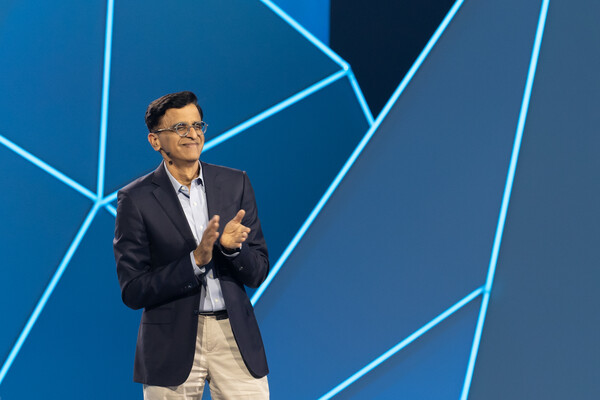
Snowflake CEO Sridhar Ramaswamy (스리다르 라마스와미) stressed in a keynote speech at Snowflake Summit 2026 that an agentic enterprise is a realistic vision. He said he would focus on supporting enterprise-wide work to run around AI agents and on removing obstacles.
He said there are four core components that make up an agentic enterprise.
The first is an enterprise’s own data, such as customer, finance and product data. The second is AI models that interpret data and connect it to action, such as Claude Opus and OpenAI models.
The third is applications that support enterprise operations, such as Gmail, Salesforce and SAP. The fourth is an Agentic Control Plane that coordinates the three elements mentioned earlier.
Among them, the control plane is a key element that plays a role similar to an operating system in an agentic enterprise.
He explained that even if individual agents are excellent, coordinated action at the enterprise level is impossible if they cannot share context, and that the control plane can cover that gap.
He said, "Without a control plane, agents operate only in isolation." He said, "A decision made by a finance agent could conflict with a supply chain agent’s decision, and a marketing agent could create content without knowing what a customer support agent just learned."
The control plane is not a distant future but is already being provided in reality. Snowflake’s control plane consists of Snowflake Intelligence and Cortex Code (Coco).
Snowflake Intelligence is a personal work agent for knowledge workers that enables access to data in natural language. Cortex Code is an AI coding agent for developers and data engineers. Ramaswamy said, "With Coco, we can complete a migration that used to take 6 months in 6 days." He added, "With natural language alone, we can turn ideas into working pipelines and applications."
If the control plane is like an operating system in an agentic enterprise, data is the starting point on the road to an agentic enterprise.
Ramaswamy said, "Data is the most defensible moat companies have and the key to making AI a relevant and differentiated asset. If data is fragmented, competitive advantage is also buried." He said, "Snowflake supports data integration through AI-based migration, Postgres support, and OpenFlow for continuous data movement. Through collaboration with Google, we can now automatically handle migration tasks that were previously difficult to complete within a few days."
Snowflake’s position is that flexibility is important when it comes to AI models.
Ramaswamy said, "The model itself is not a differentiator. Competitors can use the same model." He said, "AI delivers value when combined with enterprise-specific data. Snowflake has partnerships with major model providers such as Anthropic and OpenAI to help enterprises choose the best model depending on workloads."
Snowflake’s agentic enterprise strategy is not limited to data within the Snowflake platform. It also supports major third-party applications that companies use widely.
To this end, Snowflake is expanding investment in MCP (Model Context Protocol), an open-source technology that supports AI in using data in external applications. It recently announced it would acquire Notoma, which specialises in enterprise MCP.
Ramaswamy said, "MCP simplifies how AI systems connect to various applications." He said, "Through the Notoma acquisition, AI models will gain visibility into applications companies use, including Google Drive, Jira, Slack, GitHub and Microsoft 365. Interactions between AI and applications will operate under Snowflake’s security and access control system." He added that the Notoma acquisition means Snowflake’s governance scope is expanding beyond data to AI actions and workflows overall.
In the latter part of Ramaswamy’s keynote speech, Daniela Amodei, Anthropic’s co-founder and president, also took the stage to discuss the pace of AI development and corporate strategy. Amodei said, "If a year ago companies’ interest stayed at the level of experiments, now AI has become a core foundation across all industries, including workforce strategy, coding, finance, law and healthcare. The more computing and data you put into a model, the more predictably performance improves. Rapid progress in AI will continue." She stressed that companies should not design around current model capabilities but should set the biggest goal and start building toward it now.
 Chi-gyu Hwang
delight@d-today.co.kr
Chi-gyu Hwang
delight@d-today.co.kr