
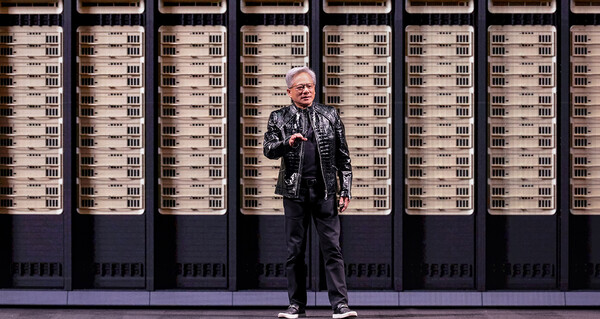
Nvidia has formalised a shift into an AI infrastructure company geared for the agent AI era beyond generative AI. Taiwan media outlet iThome reported on June 1 that Nvidia Chief Executive Jensen Huang (젠슨 황) unveiled the next-generation "Vera Rubin" platform, enterprise agent development tools and DSX for operating AI factories in the opening keynote at Computex.
Huang said useful AI has already arrived and AI is shifting from a cost-centred technology into a foundation for generating revenue. He also said corporate competitiveness over the next 10 years will depend on the ability to build, manage and operate AI infrastructure.
He said the industry has moved from generative AI to agent AI over the past two years. He explained that enterprise applications will move away from code- and operating system-centred structures and be reorganised around large language models, agent frameworks, memory systems, tools and execution environments. He said AI will move beyond simple responses to understanding context and planning workflows, and through tool calls and database access, will generate and carry out code, CAD designs, documents and business workflows.
Nvidia also introduced an enterprise agent development platform. The platform consists of the Nemotron open model, an open shell execution environment, an AI agent framework, CUDA-X function libraries, and security and governance systems. The new "Nemotron 3 Ultra" model combines SSM with a mixture-of-experts structure, raising inference speed fivefold and cutting costs by 30 percent from the previous generation. It also releases training data, training scripts and toolchains so companies can build their own agents.
It also presented use cases. A chip-design agent introduced by Nvidia and Cadence automates RTL verification, simulation and debugging, cutting a verification process that used to take weeks to several hours and boosting efficiency by more than 40 times.
On the hardware side, the next-generation AI platform "Vera Rubin" has entered full-scale production. Hopper focused on training and Grace Blackwell focused on inference, while Vera Rubin targets agent AI. It integrates the Vera CPU, Rubin GPU, NVLink 72, BlueField DPU, ConnectX-9 SuperNIC and next-generation storage devices.
Nvidia is also targeting the AI PC market. "Nvidia RTX Spark" is a chip based on TSMC's 3-nanometre process, bundling a Blackwell RTX GPU with 6,144 CUDA cores, a 20-core Grace CPU and 128GB of LPDDR5 unified memory. With Microsoft, it also built a Windows 11 platform for agents, presenting a structure in which the operating system directly uses GPUs and AI acceleration resources.
DSX was presented as a reference architecture and operating system for AI factories. It includes planning and simulation, power management, liquid cooling management, GPU placement optimisation and power grid integration functions. Huang said 40 percent of power allocation is being wasted at many AI data centres, and that dynamic power distribution, power smoothing and agent-based cooling control can raise utilisation.
 Hyunwoo Choo
cookinpapa@d-today.co.kr
Hyunwoo Choo
cookinpapa@d-today.co.kr