
The government will expand the scope of its Top-Tier visa to include professors and researchers in science and technology to attract the world's top talent.
The Ministry of Science and ICT and the Justice Ministry said on Saturday they will expand the Top-Tier visa, previously issued to employees hired by companies in advanced industries, to professors and research personnel in science and technology from June.
Competition among countries to secure core talent is intensifying, particularly in advanced strategic technologies such as artificial intelligence, semiconductors, quantum and bio. The science ministry is pursuing 'Brain to Korea' as a detailed task under a national policy assignment. It is pushing to expand recruitment programmes, strengthen settlement support and improve the visa system, aiming to attract 2,000 outstanding overseas talents by 2030. The target for this year is 600.
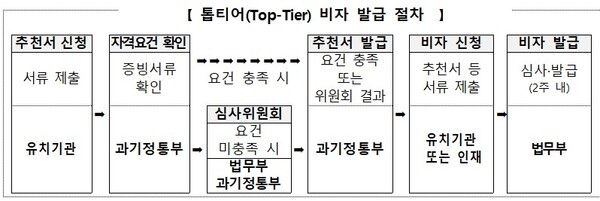
The science ministry and the Justice Ministry consulted from the visa design stage so that universities, government-funded research institutes and corporate labs can smoothly recruit outstanding researchers from overseas. They established a system linking the science ministry's recommendation of top talent in science and technology with the Justice Ministry's screening of visas and stay status.
Under the revised system, professors or research personnel in science and technology can obtain a Top-Tier visa through a science ministry recommendation if they meet at least one requirement among awards, papers, commercialisation and career experience. Institutions seeking to recruit overseas talent who want a science ministry recommendation can apply after checking the application procedure for a recommendation letter on the guidance website.
The science ministry will comprehensively review the applicant's research achievements, expertise and the need to recruit them to South Korea to confirm whether requirements are met. If quantitative requirements are met, it will issue a recommendation letter immediately. Even if quantitative requirements are not met, promising researchers with strong growth potential may be separately recommended. In that case, they will undergo a qualitative assessment by the "Science and Technology Top Talent Recommendation Review Committee," jointly involving the science ministry and the Justice Ministry.
When overseas talent recommended by the science ministry applies for a Top-Tier visa, the Justice Ministry will immediately grant a residence (F-2) visa to the applicant and family members and issue a preferred immigration card. It will also ease requirements for permanent residency by shortening the required residence period for permanent residency (F-5) from the usual 5 years to 3 years.
The science ministry plans to prioritise full-cycle settlement support services, including entry and resettlement, for top talent who ultimately receive a Top-Tier visa in science and technology after Justice Ministry screening.
Bae Kyung-hoon (배경훈), deputy prime minister and science minister, said he will continue to strengthen cooperation with related ministries, including the Justice Ministry, address difficulties in the field and actively support the inflow of outstanding researchers and stable research activities in South Korea.
Justice Minister Jung Sung-ho (정성호) said he expects the foundation to be strengthened for outstanding overseas science and technology talent to quickly enter South Korea's research field and for domestic research institutions' global research capabilities to be enhanced.
 Jin-ho Lee
jhlee26@d-today.co.kr
Jin-ho Lee
jhlee26@d-today.co.kr