
The government is accelerating efforts to secure high-quality data to prepare for the artificial intelligence (AI) era. It will build data needed by the private sector and set up a "data highway" linking public and private data. It will also push for institutional improvements related to data use, including personal information and copyrights.
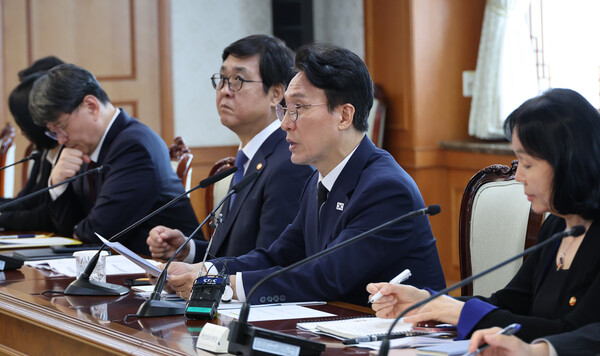
The Office for Government Policy Coordination, the Ministry of Science and ICT and other ministries met on Wednesday at the Government Complex Seoul for a meeting of relevant ministers on data chaired by Prime Minister Min-seok Kim (김민석) to discuss the "data policy 추진 direction for the era of a major AI shift." It was the first such ministerial meeting aimed at bringing together national capabilities on data, a key part of the AI ecosystem.
New prime minister-chaired body to coordinate data policy across ministries
It was the first such ministerial meeting aimed at bringing together national capabilities on data, a key part of the AI ecosystem. Data policy has so far been pursued in separate tracks by ministry functions, including private-sector and AI data led by the Ministry of Science and ICT, public data opening led by the Ministry of the Interior and Safety, and statistical data management led by the National Data Policy Committee.
The government will first focus on securing and building high-quality data needed by the private sector. It will build high-quality inference data, AI safety and reliability datasets, and performance benchmark data. It will also expand specialised data by sector, including physical AI and manufacturing, mobility, bio and health care, agriculture and culture.
It will expand the opening of public data. It will select and open an "AI and high-value public data Top 100" with strong private-sector demand. It will also provide unstructured public data, including policy research reports and national qualification exam questions and answers, in forms that are easy for AI to use. The public data management system will be improved into an AI-friendly format. The government will also push to activate the Gonggongnuri system so public works can be used for AI training.
It will also secure specialised data with high usefulness for AI transformation (AX), reflecting industry and sector characteristics such as physical AI and manufacturing, mobility, bio and health care, agriculture and culture. It will also build "data spaces" to promote sharing and use by sector, based on rules among participants and profit distribution, and apply them on a pilot basis to strategic sectors such as medical care where voluntary data sharing and use are difficult.
AI Hub to be expanded and revamped to support AX for small firms and startups
The government will strengthen the foundation for data linkage and opening to build a "data highway" where all data gathers and connects. It will upgrade the "one-window" national shared data platform to build a cross-government data pipeline linking public and private data. AI Hub, a platform for AI training data, will be expanded and revamped into an integrated provision system for AI training data.
It will also push institutional improvements for safe and reliable data use. To reduce legal uncertainty in the use of personal information and healthcare data and in the use of copyrighted works, it will push to enact and revise the Personal Information Protection Act and the Digital Healthcare Act and review the need to revise the Copyright Act. It will raise usability of 14 data safe zones nationwide through cloud linkage and expansion of unopened data, among other steps.
The government will foster a private sector-led data ecosystem. It will support small and midsize companies and startups with programmes including an "AX one-stop voucher" and a "data problem-solving bank." It will apply a tax credit for the cost of purchasing AI training data and push to recognise in-kind data contributions as self-burden when participating in government projects. It will also push to prepare standard contracts that consider both copyright protection and the development of the AI industry.
Based on the discussions, the government will detail tasks and move to draw up a legally mandated master plan. It also plans to build a data strategy map presenting AX directions by sector to support data securing and use by ministries and agencies.
Kim said, "Without advancing data across all areas of society, there is no development of national AI," and added, "Through the meeting body of relevant ministers on data, I will prepare close cooperation among ministries and consistent policy."
Deputy Prime Minister Kyung-hoon Bae (배경훈), who is also science and ICT minister, said, "Within the golden time for AI innovation, relevant ministries will actively support as one team so data needed in the field can be used in a timely manner."
 Jin-ho Lee
jhlee26@d-today.co.kr
Jin-ho Lee
jhlee26@d-today.co.kr