
Biohub has released for free to the research community artificial intelligence systems used for protein structure prediction, design and discovery.
On May 28, local time, online media outlet Gigazine reported that the release is largely aimed at replacing a significant part of the process of finding protein-based therapeutic candidates with computation to speed up drug development.
The released system consists of three pillars: ESMC, ESMFold2 and ESM Atlas. All three tools are provided free to researchers worldwide through the Biohub platform. Biohub is an organisation that combines AI and biology to pursue research aimed at solving diseases, and it is supported by Meta CEO Mark Zuckerberg.
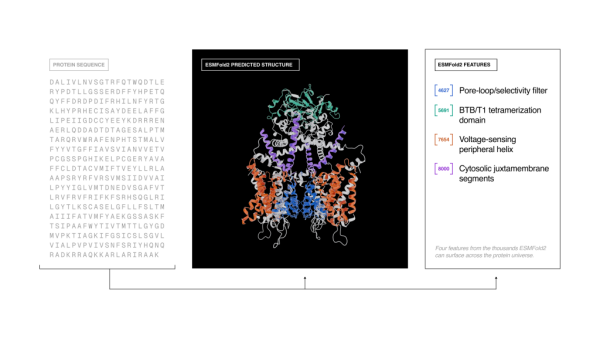
The core is an integrated structure that links the entire protein research process into a single flow. ESMC is a language model trained on about 2.8 billion protein sequences collected across living organisms. It serves as a foundation for understanding protein patterns and characteristics. ESMFold2 is a design engine that predicts the three-dimensional structure of biomolecular complexes based on this sequence information. It focuses on identifying protein structures likely to bind strongly to specific targets such as tumours.
ESM Atlas is designed to enable searches across 6.8 billion protein sequences and 1.1 billion predicted structures using ESMC representations. It was explained that it can be used to discover relationships not captured by existing databases and to find new candidate materials. Biohub is seeking to integrate the research process from protein discovery to structural design and candidate search through this.
On performance, a comparison with Google’s AlphaFold3 was also presented. Biohub said ESMFold2 delivered performance that exceeded or was similar to AlphaFold3 in predicting protein-protein interactions and antibody-antigen interactions. This shows an intention to increase usefulness at the actual therapeutic design stage beyond simple structure prediction.
The release also strongly targets bottlenecks in antibody therapy development. Biohub explained that antibody therapies are becoming more important in cancer and autoimmune disease, but that it usually takes 3 to 4 years to find promising candidates. It claimed that using ESMFold2 could perform a significant part of early exploration through computation and produce designs ready for experiments within days.
Priscilla Chan (프리실라 챈), a co-founder of Biohub, said, “If we make these tools available for free, researchers around the world can move quickly toward treatments that are better suited to each patient.” This means lowering access barriers to speed up experimental design and candidate discovery.
Competition in AI-based protein research is also expected to intensify. Through this release, Biohub is seeking to expand its influence beyond a competition over research performance to the market for tools that support the discovery of actual therapeutic candidates. As it has stressed performance in key drug development areas such as antibody-antigen interactions, how quickly use cases increase in research settings is expected to be a point to watch going forward.
 Jinju Hong
hongjj@d-today.co.kr
Jinju Hong
hongjj@d-today.co.kr