
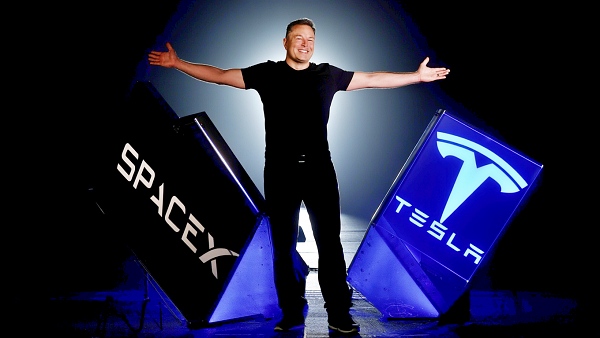
Ahead of SpaceX’s Nasdaq listing, talk that Tesla and SpaceX could merge is resurfacing.
On May 26 local time, CNBC reported that Elon Musk (머스크) has discussed with close associates the possibility of bundling the two companies into one. It also reported that a perception is spreading inside Tesla that such a deal could ultimately happen.
The key backdrop is SpaceX’s initial public offering. After merging with AI company xAI earlier this year, SpaceX was valued at $1.25 trillion in the private market. It is expected to begin Nasdaq trading in two weeks. Tesla’s current market capitalisation is about $1.6 trillion, and if the listing becomes reality Musk would lead two of the top U.S. companies by market value at the same time.
The two companies already share businesses and resources closely. They appear different as a rocket company and an electric-vehicle maker, but both are focused on securing talent and computing resources needed to build AI infrastructure and services, which is cited as a link between them.
Expanding AI investment is also cited as a factor lending weight to the merger talk. SpaceX spent more than three quarters of its $10.1 billion in first-quarter capital expenditure on AI-related areas. Tesla also said in a recent earnings report that this year’s capital expenditure will rise by about three times to exceed $25 billion.
Tomasz Tunguz of venture capital firm Theory Ventures said Tesla must run in-vehicle AI systems within limits on power, cooling, latency, reliability and cost, while SpaceX must solve computing challenges in the orbital environment. That means the two companies operate under similar technical constraints, he said. He added that a merger of this scale would inevitably be complex.
A business combination between Tesla and SpaceX is already showing up in many places. Tesla invested $2 billion in xAI in January, and that stake was folded into SpaceX’s assets when xAI merged with SpaceX the following month. SpaceX said in a securities filing it bought $697 million worth of Tesla Megapack battery energy storage systems to supply power to xAI data centres in 2024 and 2025. In 2025 it also purchased $131 million worth of Tesla Cybertrucks.
In addition, Tesla supplied SpaceX with solar equipment and vehicle parts, and Tesla used SpaceX private jets. SpaceX capabilities were also used to develop special alloys for the Cybertruck. The structure is also reflected in the fact that suppliers view Musk’s various companies as effectively one large customer. A representative case is Nvidia shifting $500 million in GPU orders for Tesla to xAI in 2024 at Musk’s request.
The overlap between the two companies is also large in corporate governance. Musk serves on both boards, and his brother Kimbal Musk (킴벌 머스크) and venture investor Ira Ehrenpreis (아이라 에런프라이스) are also on both boards. SpaceX directors Antonio Gracias (안토니오 그라시아스) and Steve Jurvetson (스티브 저벳슨) previously served as Tesla directors. Charles Kuehmann (찰스 큐먼), formerly of Apple, is vice president of materials engineering at both Tesla and SpaceX.
Still, if an actual merger is pursued, the biggest issue is likely to be shareholder interests rather than antitrust. Legal experts said difficult questions would remain, including which company would be the parent, how to set the stock swap ratio, and who would determine a fair price. SpaceX, in particular, defined itself as a “controlling company” in its securities filing and specified that, with Musk holding 85 percent of voting rights, safeguards for ordinary shareholders could be limited even after listing.
Musk’s personal compensation structure is also in focus. SpaceX set compensation criteria of reaching a $7.5 trillion market capitalisation and securing 1 million residents on Mars. Tesla has also won shareholder approval for a 12-tranche compensation plan tied to market value and operating performance. Ross Gerber (로스 거버), CEO of investment firm Gerber Kawasaki, said that if the two companies are combined it would help Musk realise a plan to run one large company, and could also make it easier to raise funds and borrow what is needed for AI competition with Google.
The market is also seeing that a SpaceX listing could further amplify discussion of combining with Tesla. Tezpal Bhatia (테즈폴 바티아), a SpaceX early investor and CEO of space financial infrastructure startup Nevecs, said, “The space market will grow bigger after the SpaceX IPO.” If SpaceX’s value is re-evaluated in the public market, discussion over whether to keep the two companies separate or combine them could also become more concrete.
This merger talk goes beyond a simple corporate governance issue and shows that Musk’s companies are moving in a way that binds AI infrastructure, power and computing resources around a single axis. That is also why the possibility of a combination between SpaceX and Tesla continues to draw attention after the listing.
 Yoonseo Lee
yslee@d-today.co.kr
Yoonseo Lee
yslee@d-today.co.kr