
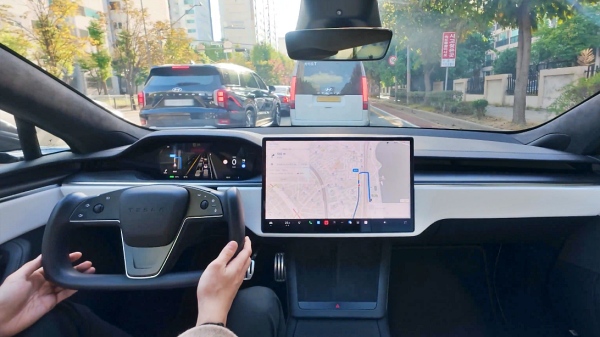
[Digital Today reporter Jinju Hong (홍진주)] Tesla has moved to adjust its full self-driving (FSD) strategy in the China market. FSD adoption in China has been formalised, but the actual rollout timing remains uncertain. Tesla has also changed the name to “Tesla assisted driving,” signalling a move to respond to regulations.
As strategic changes continue to match China’s regulatory environment, attention is also focusing on when Tesla may expand into other Asian markets such as South Korea.
• Tesla formalises China FSD, but actual rollout timing unclear… when will it come to South Korea? • Tesla changes FSD name in China to ‘Tesla assisted driving’… was it mindful of regulation?
Tesla is facing a series of variables in its production and supply-chain strategy. A plan to set up a factory in India that it has pursued for more than 10 years has been scrapped after prolonged negotiations. Weak sales and spare capacity at existing facilities are cited as the background.
It has also carried out a recall after some Model Y vehicles were missing weight labels due to a factory equipment error. Tesla has continued to adjust the performance of a lower-priced Model 3. The atmosphere is that pressure is increasing across production, quality and product competitiveness.
• Tesla scraps India factory plan after 10 years of talks… weak sales and idle facilities overlapped • Tesla missing weight labels due to factory equipment error… mass recall of Model Y • Tesla again revises specs of low-priced ‘Model 3’ in Canada… acceleration performance lowered from 4.2 seconds to 6.2 seconds
Competitive pressure around Tesla is also increasing on all fronts. Chinese companies are dominating the ultra-low-priced EV market below $10,000 on the back of price competitiveness. With an additional push from BYD, the fight for market leadership is intensifying.
Einride has started operating Level 4 electric trucks. Rivian is also moving to target demand leaving Tesla by touting the upcoming launch of the R2, making the competitive landscape more complex.
• China’s ‘value-for-money trio’ closing in on Tesla… takes top 5 spots with models below $10,000 • Tesla weak as SpaceX listing mood builds… compounded by BYD offensive • Tesla offers only ‘promises’… Einride begins operating Level 4 electric trucks • Rivian targets Tesla defectors… ‘R2’ hits optimal timing for a 2026 launch
Volvo is accelerating its software-defined vehicle strategy by putting forward a next-generation EV platform and AI functions. The new EX60 applies Google Gemini-based AI functions linked to external cameras, expanding the scope of interaction between the vehicle and users.
It is also introducing the first SPA3 platform and cell-to-body technology, stepping up moves to strengthen EV efficiency and the digital experience at the same time.
• If asked, “Can I park here?” it answers… Volvo EX60 adopts ‘Google Gemini’ linked to external cameras • Volvo EX60 launches as the first SPA3 EV… applies cell-to-body
In the EV market, a phase of polarisation is being rapidly reshaped alongside structural transition. The International Energy Agency (IEA) forecasts that EV market share will reach 30 percent in 2026. As the energy transition accelerates, the competitiveness gap across the industry is widening.
Meanwhile, cost-structure factors such as charging fees and efficiency differences are determining market success, highlighting the importance not only of the pace of electrification but also of operating strategy.
• IEA: EV market share expected at 30 percent in 2026… record high amid energy crisis • EV market ‘K-shaped polarisation’… companies slow to transition lose ground in global competition • The reality of EV charging costs… time-of-day pricing and efficiency differences made the divide
Domestic mobility companies such as TMAP Mobility, Kakao Mobility and Socar are accelerating service upgrades centred on data and AI.
From analysing usage data to track shifts in tourism trends to developing sensing technologies for autonomous driving and AI-based vehicle diagnostics, the mobility industry is rapidly evolving into a “data and AI-based platform.”
• ‘Hip Buddhism’ boom in TMAP data… visits rise to temples including Bulguksa and Naksansa • Kakao Mobility-LG Innotek begins developing autonomous driving sensing solution • Socar cuts faults by 22 percent with AI tyre diagnostics
Lectric is moving to target the market with the value-for-money electric bicycle “XPress 2.” LiveWire is entering the race for urban mobility by launching a small electric motorcycle in the 125cc class.
As value-focused electric bicycles and small electric bikes appear in the market at the same time, competition is expanding in personal mobility around practicality and accessibility.
• This spec at this price?… Lectric XPress 2 targets value-for-money electric bicycles • LiveWire makes a play with a small 125cc-class electric motorcycle… launching this summer
 Jinju Hong
hongjj@d-today.co.kr
Jinju Hong
hongjj@d-today.co.kr