
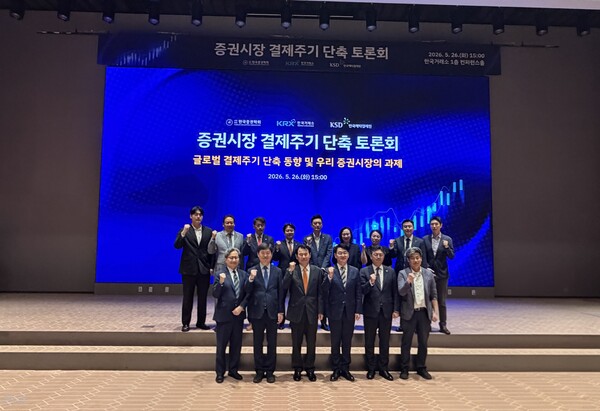
Discussions are gaining pace on shortening the settlement cycle in South Korea's stock market from the current T+2 to T+1. The securities industry and related agencies stressed that stable preparations across back-office operations must come first, including foreign investor settlement and currency conversion, securities lending, exchange-traded fund (ETF) creation and redemption, and system upgrades.
On May 26, the financial investment industry said a forum was held at the Korea Exchange on shortening the stock settlement cycle. South Korea's stock market currently uses the T+2 system, in which settlement is completed 2 business days after the trade date.
After President Lee Jae-myung (이재명) directly mentioned the issue at a capital markets meeting in March, talks on institutional improvements began in earnest, centred on the Regulatory Rationalisation Committee, the Financial Services Commission and related agencies.
Major global markets have already moved to shorten settlement cycles. The United States completed its shift to T+1 in May 2024. European markets such as Britain, the European Union (EU) and Switzerland are preparing to shorten settlement cycles, targeting October 2027. Hong Kong has also published an implementation timetable from April 2026 to the fourth quarter of 2027, adding momentum to discussions in Asia as well.
Preparatory work is also under way in South Korea. The Korea Exchange and the Korea Securities Depository commissioned the Korea Capital Market Institute in 2023 to study the feasibility of pushing for a shorter settlement cycle. In 2025, they launched a working group to shorten the settlement cycle and gathered views from market participants. They are also preparing to draw up a practical standard plan for tasks related to a shorter settlement cycle in the second half of this year.
The securities industry viewed the shift to T+1 as work that changes overall systems, not a simple schedule adjustment. Noh Seung-jin (노승진), a division head at Mirae Asset Securities, pointed to improving efficiency in handling settlement for foreign investors as a key task.
Noh said, "Foreign investors still depend on manual-based settlement confirmation procedures under the physical constraint of time differences." He said, "If electronic automation is not established among clients, custodian banks, brokerages and the Korea Securities Depository, settlement delays could lead to failed settlement."
Jo Eun-ah (조은아), a division head at SK Securities, said, "From the perspective of the Korea Securities Depository and brokerages, shortening the settlement cycle is effectively an issue that requires redesigning overall systems." She said revisions and verification are needed across programs directly tied to client assets, including ETF creation and redemption, AP and LP operations, securities lending, margin processing, the grace period for unsettled purchases, the calculation and display of deposits, scheduled forced liquidation, and credit provision.
Custodians for foreign investors raised concerns about currency conversion and the possibility of failed settlement.
Kim Mi-kang (김미강), a director at SC First Bank, said, "In the case of non-resident foreign investors, separate work is needed from the trade date to the settlement date, so practical considerations are necessary."
She also said a shorter settlement cycle could concentrate demand for currency conversion, leading to increased exchange-rate volatility and higher costs from failed foreign exchange settlement.
Related agencies agreed on the need for the shift but presented automation and operational standardisation as key tasks.
Park Sang-wook (박상욱), head of the Clearing and Settlement Division at the Korea Exchange, said, "The shift to T+1 is the direction we should go in terms of improving convenience for retail investors and efficiency in fund management, reducing settlement risk across the market, and cutting margin requirements."
He stressed that if implementation proceeds while any part remains insufficiently prepared, settlement stability could be undermined and lead to a decline in market trust.
The Korea Securities Depository cited the complexity of institutional settlement as a key task.
Choi Hang-jin (최항진), head of the Securities Settlement Division at the Korea Securities Depository, said, "On-exchange market settlement can be handled relatively because it is completed through clearing and settlement among the exchange, brokerages and the depository, but institutional settlement among foreign institutional investors, asset managers and securities firms is difficult to handle due to overlapping and multi-layered work processes."
To introduce settlement automation infrastructure, the depository completed system upgrades in late April to overhaul the messaging system that transmits settlement information between securities firms and custodian banks. It is also reviewing the construction of a system to match and confirm fund-level transaction information in real time.
Financial authorities said they share the view that the shift is needed but that a process is required to reduce concerns among stakeholders.
Ko Young-ho (고영호), head of the Capital Markets Division at the Financial Services Commission, said, "Everyone agrees on shifting to T+1, but the issue is when and how." He said, "Transition costs always arise when changing a system, and we revise the system while reducing those costs."
He said the domestic market structure and financial order should be considered alongside the transition, rather than copying overseas systems as they are. He said the won is not a hard currency freely traded like the dollar, so stability considerations by foreign exchange authorities are needed, and that areas such as account opening and real-name requirements, settlement failure rates, short-selling rules and other factors reflect characteristics specific to the South Korean market.
Park Yong-jin (박용진), vice chairman of the Regulatory Rationalisation Committee, said the introduction timing should be brought forward as much as possible.
Park said, "I urged the Financial Services Commission and related agencies to bring forward as much as possible the introduction timing, which is currently planned for around October next year." He said, "A public explanation is needed so the public can understand why system improvements are being delayed."
Jung Eun-bo (정은보), chairman of the Korea Exchange, also described the shift to T+1 as a new standard in global capital markets but stressed stable implementation.
Jung said, "Shortening the settlement cycle is not a task that can be pushed forward through the efforts of any single institution alone." He said all work processes and infrastructure need to be upgraded, from trade confirmation after execution to clearing, currency conversion and settlement.
 Sangyeop Oh
yub@d-today.co.kr
Sangyeop Oh
yub@d-today.co.kr