
Criticism emerged that securities firms’ profit structure may be behind delays in switching to T+1, after it was found brokers earned 180.5 billion won in interest income over the past three years while holding clients’ settlement funds.
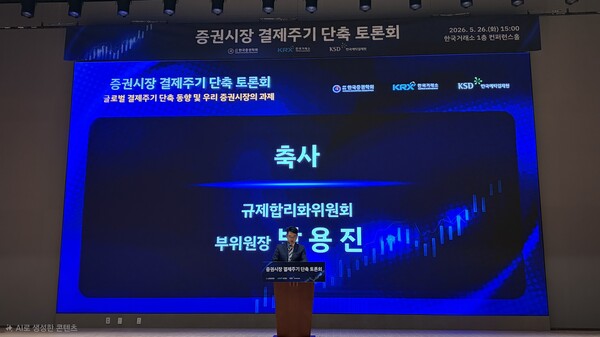
At a forum on shortening the stock settlement cycle held at the Korea Exchange on May 26, Park Yong-jin (박용진), vice chair of the Regulatory Rationalisation Committee, said the reality is that after selling shares, investors must wait 2 business days for the proceeds. He said the wait can stretch to 4 or 5 days when holidays intervene.
South Korea’s stock market currently applies a T+2 system, with settlement taking place 2 business days after the trade date. Even after an investor sells shares, it takes time before cash can be withdrawn or secured for reinvestment.
The United States shortened its settlement cycle to T+1 in 2024, and Europe and Hong Kong have also announced T+1 transition timetables. Korea Exchange Chairman Jung Eun-bo (정은보) said T+1 settlement is becoming a new standard for global capital markets, not a choice limited to some markets.
Park stressed the start date should be brought forward as much as possible. He said he urged the Financial Services Commission and related agencies to bring forward the introduction date, currently set for around October next year. He also said the public should be given a transparent explanation, through open forums, of progress, difficulties and issues that can be resolved.
He said individual investors find it hard to accept the reasons for the delay in improving the system. Park said the public does not understand why the system can only be improved in October next year and cannot accept why it must be aligned with the EU and Hong Kong timetables.
He also said explanations citing exchange rates and time differences were unconvincing, referring to retail investors who directly invest in overseas stocks.
Broker interest income also emerged as an issue. Park said interest income earned by 12 securities firms from clients’ settlement funds held for 2 days each over the past three years amounted to 180.5 billion won. He said it was natural that suspicion persists that brokers’ large profits are becoming an obstacle to improving the system.
The exchange agreed on the need to shorten the settlement cycle but stressed stable implementation. Jung said it is not a task that can be pursued by the efforts of any single institution alone. He said it requires overhauling all work processes and infrastructure, from trade confirmation and clearing after execution to foreign exchange conversion and settlement.
He said shortening the settlement cycle to T+1 means aligning South Korea’s capital markets with global markets. He said the goal is not only to move fast but also to find ways to move together without side effects.
The exchange said it will work to ensure T+1 takes root early and successfully by communicating with the government, the industry, related institutions and investors.
Shortening the settlement cycle is seen as a step that can improve retail investors’ use of funds and boost market efficiency. If the time required to recoup sale proceeds is reduced, investors can deploy funds more quickly and the domestic stock market’s global consistency would increase.
Park said shortening the settlement cycle is not just a difference of a few days. He said it is about restoring the freedom to manage funds for millions of retail investors.
Still, during the transition, adjustments are needed to back-end infrastructure, including settlement for foreign investors, foreign exchange conversion tasks, and systems at securities firms and the Korea Securities Depository. As overall processing times across the market are reduced, criticism has emerged that error response and risk management systems should also be strengthened.
 Oh Sang-yeop
yub@d-today.co.kr
Oh Sang-yeop
yub@d-today.co.kr