
Sensor Tower released a status report on Tuesday that comprehensively analysed changes in global web traffic, the advance of generative artificial intelligence (AI) platforms and the share of local platforms by country.
The report said total web visits last year fell about 1.8 percent from a year earlier to about 800 trillion, and time spent on the web fell 5 percent to about 1.6 trillion hours. It attributed the decline in web time in major markets such as the United States, Japan and Western Europe to the post-pandemic recovery in offline activity and a rising share of mobile app use. India, however, posted a 7 percent rise in sessions and Vietnam saw time spent increase 6.3 percent, showing growth. Brazil, Indonesia and South Korea were broadly flat overall.
By device, mobile accounted for more than half of total web visits in the first quarter of 2026. The rise in mobile share was particularly pronounced in France, Germany, Singapore and the United Arab Emirates. In time spent, however, desktop kept the lead, accounting for more than 70 percent of the total, reflecting preferences for longer browsing and immersive content consumption.
In the global web ecosystem, Google Search and YouTube ranked first and second last year with more than 1.6 trillion visits combined. Google also ranked No. 1 globally with a monthly average of 2.9 billion in an actual audience metric that measures unique users across mobile apps, mobile web and desktop web.
Local platforms were strong in South Korea and Japan. In South Korea, Naver ranked first among all platforms by actual audience, while Yahoo! Japan ranked second in Japan.
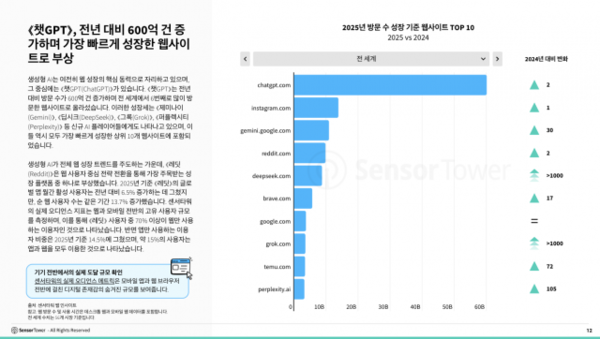
Generative AI served as the most prominent growth driver in the global web market. ChatGPT increased visits by about 60 billion from a year earlier and ranked sixth in global website visits. Time spent also surged by 21.7 billion hours, marking the biggest increase among all websites.
Other major AI platforms, including Gemini, DeepSeek, Claude, Grok and Perplexity, were also included among the top 10 websites for growth in global visits. By category, visits to AI assistants surged 86 percent from a year earlier, while education and training fell 7 percent and news declined 6 percent, showing demand for information searches shifting to AI.
The main cited sources for ChatGPT-generated answers were jobs and education at 16 percent, software at 15 percent, news at 10 percent, law and government at 9 percent, blogs at 7 percent, shopping at 6 percent and financial services at 5 percent.
Sensor Tower said its report analysed that the trend shows AI assistants evolving beyond simple search tools into trust-based interfaces that support consumer decision-making, financial judgement and understanding of regulation.
 Lee Ho-jung
lhj@d-today.co.kr
Lee Ho-jung
lhj@d-today.co.kr