
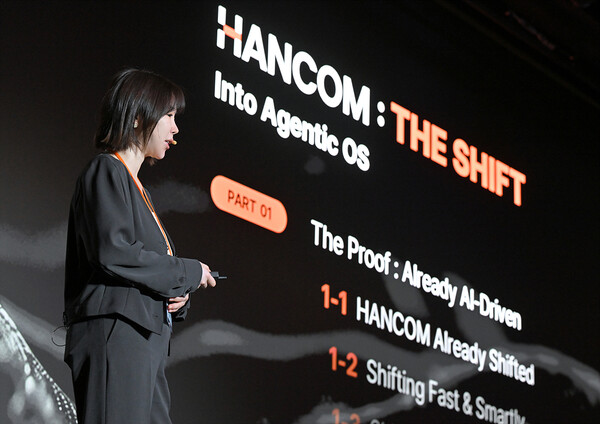
Hangeul and Computer will also change its corporate name to Hancom and go all-in on its AI business. It is accelerating its transformation into a sovereign agentic OS company.
Hancom’s agentic OS aims to provide a single platform for users to develop and share AI agents that carry out work tasks. It also aims to integrate authentication and permission management, data access and other required functions. It is described as an integrated AI agent operating system that connects and controls internal organisational data, external AI models, existing work systems and permission structures in one secure environment.
Hancom plans to release a beta version of its agentic OS in June. In the second half, it plans to unveil a version verified in customer environments. Its goal is a full launch in 2027.
Offering a platform that lets companies build and manage customised AI agents is not entirely new. Many companies, including global firms, have recently been emphasising similar visions. As a result, attention is focused less on the fact that Hancom is doing an agentic OS and more on how it will secure a presence in the tech market with it.
On this, Hancom CEO Kim Yeon-su (김연수) made clear that Hancom is qualified to pursue an agentic OS. At a press briefing hosted by Hancom on May 19, he said, "This is not a far-future blueprint. We are already proving it with results and technology," showing confidence.
According to Kim, the sovereign agentic OS is designed in six layers, and Hancom has competitiveness in Levels 1, 4 and 6.
Level 1 is the unstructured-data source technology. It focuses on converting internal corporate documents into data that AI can read. Level 4 is the system execution layer. It is an integrated engine that connects various internal and external systems to carry out actual work. Level 6 is the data sovereignty management layer. Kim stressed, "With security control technology verified in public and national environments, our track record of doing business for 36 years with government bodies, public institutions and educational institutions is an area competitors cannot catch up in."
He also stressed an open-source strategy to expand its share of the sovereign agentic OS market, citing as a representative example Hancom’s decision to release as open source its Open Data Load (ODL), which extracts and structures PDF data.
Kim said, "ODL version 2.0, released in March 2026, ranked No. 1 globally in all four benchmark categories. It outperformed global competing products with an overall score of 90 percent, reading order 94 percent, table extraction 93 percent and title recognition 83 percent."
Another point Kim stressed was AX clinical data capabilities for validating AI. Kim said, "Hancom has accumulated extensive experience in step-by-step verification of AI transformation projects. Through market release and commercialisation, we completed verification of Hancom’s core technologies. Hancom itself became a huge AX clinical environment." He added, "By bringing various external agents into our internal environment, we secured more than 750 cases of work efficiency improvements. We also secured large AX references, including external pilots and domestic library AI projects, proving our technological capabilities."
At the briefing, Kim also presented as a differentiator that Hancom’s AI revenue is already rising rapidly on the back of its base of 200,000 client companies.
Kim said, "100 percent of central government ministries, 100 percent of education offices nationwide, and about 1,500 companies in finance and other security-sensitive industries are already Hancom customers." He added, "In 2025, Hancom’s separate revenue was 175.3 billion won, up 16.2 billion won from a year earlier. Of that, 54.6 percent came from AI. It is a structure that secures both top-line growth and profitability through existing customers without new customer acquisition costs."
Hancom is also treating open architecture as a key term in targeting the sovereign agentic OS market.
Kim said, "We do not obsess over developing our own LLM. We focus on integrating the data source, execution, openness and governance environment, and we support an LLM-neutral structure so customers can freely choose an LLM." He added, "It is the same approach as Palantir targeting the global market by combining a data integration platform and an agent platform without its own LLM."
 Hwang Chi-gyu
delight@d-today.co.kr
Hwang Chi-gyu
delight@d-today.co.kr