
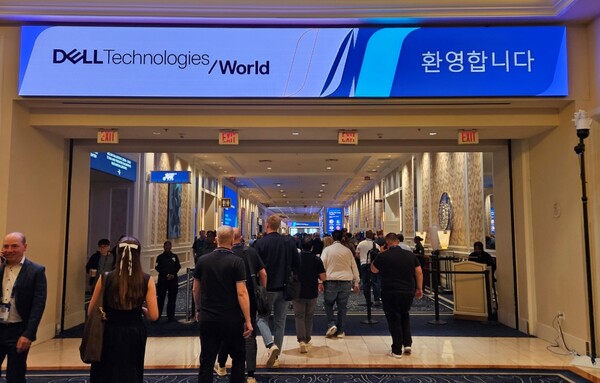
[Las Vegas, United States = Digital Today reporter Jin-ho Lee] Dell Technologies is expanding innovation in artificial intelligence factories in partnership with Nvidia. It aims to turn AI into tangible business results by strengthening everything from local workstation-based agentic AI to data platforms and an open ecosystem.
Dell held Dell Technologies World 2026 (DTW 2026) in Las Vegas on May 18 (local time). On the first day of the event, Dell announced updates to the Nvidia-based Dell AI Factory. Dell AI Factory is a portfolio designed to help companies build AI with trusted data and controllable infrastructure and scale it for specific purposes.
AI factory innovation based on Nvidia... expansion of agentic AI
Through innovation in the Nvidia-based Dell AI Factory, Dell is expanding agentic AI, data platforms, next-generation infrastructure and an open ecosystem. Its 'Dell Desk-Side Agentic AI' lets companies build and operate autonomous AI agents in local environments, reducing concerns about moving corporate data outside the company.
Desk-Side Agentic AI is provided on Dell high-performance workstations and Nvidia Nemo Cloud. It is designed to allow companies to run autonomous AI agents securely without exporting data externally. Dell explained that this can turn volatile cloud token costs into predictable infrastructure investment.
Dell is also applying Nvidia OpenSheath, a secure runtime for autonomous AI agents, across the Dell AI Factory. Dell said it can deploy AI agents and apply governance across a range of environments, including Pro Precision Tower, Pro Max with GB10 and GB300, and the PowerEdge XE server family.
Faster transition to operations with AI data platform... up to 6 times better SQL performance
Dell is also focusing on converting corporate data into assets suitable for AI use. Through its 'AI Data Platform Integration Service', Dell supports customers in resolving key challenges such as data preparation, shortages of specialized personnel and operational complexity, and in quickly moving AI pilot projects into production environments.
Dell strengthened orchestration and search functions in its AI data platform to index billions of unstructured files and connect them to governance-based data pipelines. The Starburst-based Dell Data Analytics Engine provides up to 6 times faster structured query language (SQL) query performance on Nvidia Blackwell graphics processing units (GPUs). Dell plans to support the Vera platform in the future.
Dell also unveiled new storage. Dell ObjectScale X7700 provides up to 45 percent higher hard disk drive (HDD) capacity than the previous generation. Dell plans to integrate storage and the search engine for the Nvidia-based AI data platform with Nvidia Omniverse libraries to provide scalable object storage and semantic and vector search. It will directly connect product lifecycle management (PLM) systems and various data repositories to Omniverse, supporting digital twins and physical AI training.
Expansion of PowerEdge-based data centers... stronger rack-scale infrastructure
Dell expanded its AI infrastructure portfolio by adding new systems optimized for enterprise AI workloads. It introduced 'Dell PowerRack' to support implementation of next-generation AI infrastructure.
Dell PowerRack is a solution designed as an integrated system combining computing, networking and storage. It incorporated thermal design, power management and software optimization from the early engineering stage. It reduces the integration burden that arises when assembling individual components and supports enterprise-scale AI and high-performance computing (HPC) workloads.
PowerRack storage and networking solutions use factory-integrated, dedicated Dell exascale storage and Dell PowerSwitch. The system optimizes performance, power and cooling, and all resources are managed consistently through the Dell Integrated Rack Controller.
Dell also presented next-generation cooling technology. Dell PowerCool CDU C7000 is a 4U, 19-inch form factor rack-mounted cooling distribution unit. It is designed to meet the cooling requirements of Nvidia's Vera Rubin NVL72 platform. It expands cooling capacity and supports facility cooling water of up to 40 degrees Celsius.
Expansion of an open ecosystem... ecosystem program provided
Dell is also expanding its AI software ecosystem. The newly announced 'Dell AI Ecosystem Program' supports AI software companies in validating their solutions on Dell AI Factory infrastructure. Dell expects this to reduce risks that arise when companies move from proof of concept (POC) to real operational environments.
Dell is working with Google Distributed Cloud to run the Gemini 3 Flash model on Dell PowerEdge XE9780 servers. With OpenAI, it is co-developing solutions based on OpenAI Codex. It plans to integrate them with the Dell AI Data Platform (AIDP) to provide OpenAI's latest agentic execution framework in on-premises environments.
Palantir's Foundry and AI platform will be provided in the on-premises environment of the Dell AI Factory. Dell is building Palantir's ontology layer on Dell ObjectScale and PowerFlex to connect data within companies and support AI-based business process automation. It is also cooperating with SpaceXAI to provide Grok's advanced reasoning and multimodal capabilities in the form of an enterprise AI assistant.
Chairman Michael Dell (마이클 델) said, "As agentic AI emerges, companies that cannot quickly turn intelligence into tangible business outcomes will inevitably lose competitiveness." He added, "Dell supports customers in turning data into fuel for AI on infrastructure where they can directly control security, governance and cost efficiency."
Nvidia CEO Jensen Huang (젠슨 황) made a surprise appearance in the first day's keynote speech and received loud cheers. Huang signed Dell PowerRack himself, highlighting the cooperative relationship between the two companies.
He said, "As the era of agentic AI arrives in earnest, corporate adoption of AI is entering a phase of explosive growth." He added, "Dell and Nvidia are jointly building a scalable full-stack AI factory from the desktop to the data center."
 Jin-ho Lee
jhlee26@d-today.co.kr
Jin-ho Lee
jhlee26@d-today.co.kr