
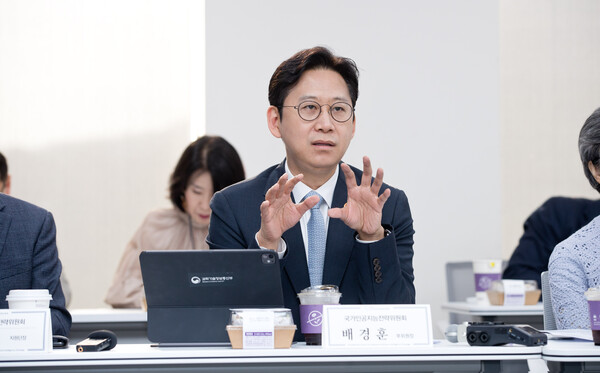
The centre of gravity in the government's artificial intelligence (AI) policy control tower is shifting toward Vice Prime Minister Bae Kyung-hoon (배경훈), who also serves as minister of science and ICT. Ha Jung-woo (하정우), former senior presidential secretary for AI future planning, has entered a by-election race. Lim Moon-young (임문영), former standing vice chair of the National AI Strategy Committee, is also running in an election.
As key figures leading national AI policy leave vacancies in succession, Bae's burden has grown. In addition to his role of coordinating AI policy across ministries, he will oversee operations of the National AI Strategy Committee for the time being. For now, Bae's moves are expected to become a barometer of the national AI strategy.
AI policy control tower vacuum... Bae Kyung-hoon's role expanded
The National AI Strategy Committee recently said Bae will temporarily also serve as standing vice chair following Lim's resignation and dismissal. Bae chaired the 18th steering committee meeting, marking his first official schedule as standing vice chair of the AI strategy committee.
The industry assesses the situation as meaning more than a simple expansion of duties. Government AI policy has so far operated as a "triangular formation" centred on the senior AI secretary, the standing vice chair of the National AI Strategy Committee and the science and ICT minister. The senior AI secretary served as an adviser setting the national AI agenda, the AI strategy committee acted as a designer setting the direction for pan-government AI policy, and the science ministry functioned as the lead ministry in charge of budgets and project execution.
But with Ha and Lim entering elections in succession, two axes of the triangular formation have weakened at once. The government is using Bae as much as possible to minimise the vacuum. It is interpreted as a view that, given expertise in AI and policy continuity, it is more stable for Bae, who understands the existing flow, to take charge of operating the AI strategy committee as well.
Growing burden of policy coordination... execution tasks pile up
Still, there is an assessment in the field that the burden placed on Bae is not small. The science ministry has a broad scope of work, including science and technology, research and development (R&D), telecommunications, postal services and cybersecurity, in addition to AI. An industry official said, "With key AI advisers leaving for elections, it has become a situation that the field cannot help but worry about," adding, "He also has to take care of space and science and technology, so Bae's burden has become very heavy."
It is also a burden that a large number of AI tasks the government is pursuing have piled up. The National AI Strategy Committee said that, after checking implementation of the "Republic of Korea AI Action Plan" in the first quarter this year, 288 of 326 tasks were being 추진 as planned.
Put another way, it also means 38 tasks need supplementation. The committee plans to additionally review inter-ministry cooperation systems and ways to secure budgets. Along with the implementation check results, it will also address support for planning new R&D projects in 2027, a plan to 추진 support for non-R&D efforts, and the status of the AI legislative framework. Bae has taken on the heavy responsibility of managing AI policy planning and budgets, legislation and performance management all at once.
Expanding AI infrastructure is also a key test for Bae. The government is pursuing major support projects including securing advanced graphics processing units (GPUs), building a national AI computing centre, expanding AI data centres and supporting development of independent AI foundation models. Precisely adjusting the pace of 추진 and priorities of the tasks is also Bae's job.
Industry expects field experience, but swift follow-up appointments are key
Even so, the industry expects Bae's on-the-ground experience to shine. Bae, a former head of LG AI Research, has broad experience in AI research and service development. He was assessed as relatively well understanding companies' difficulties and needs.
Recently, he has also been showing confidence in South Korea's AI technological competitiveness. At a recent "Science and Technology-AI Future Strategy Meeting", Bae stressed, "There are always only questions about Korea participating in Anthropic's Glasswing project," and added, "There should be questions about whether Korea can build a model at the level of Mythos." The remark was intended to say that, as the country aims to become one of the world's top three AI powers, it should be more confident.
Still, regardless of Bae's individual capabilities, stability of the AI control tower remains a task. AI policy is a field where both speed and depth matter. If the vacancies for the senior AI secretary and the standing vice chair of the AI strategy committee are prolonged, the burden of policy coordination could be excessively concentrated on Bae. That has prompted views that swift follow-up appointments are needed.
Another industry official said, "It does not seem easy to find a person with both administrative experience and a technology domain," adding, "For the time being, Bae's moves will determine how future (AI) policies are felt."
 Jin-ho Lee
jhlee26@d-today.co.kr
Jin-ho Lee
jhlee26@d-today.co.kr