
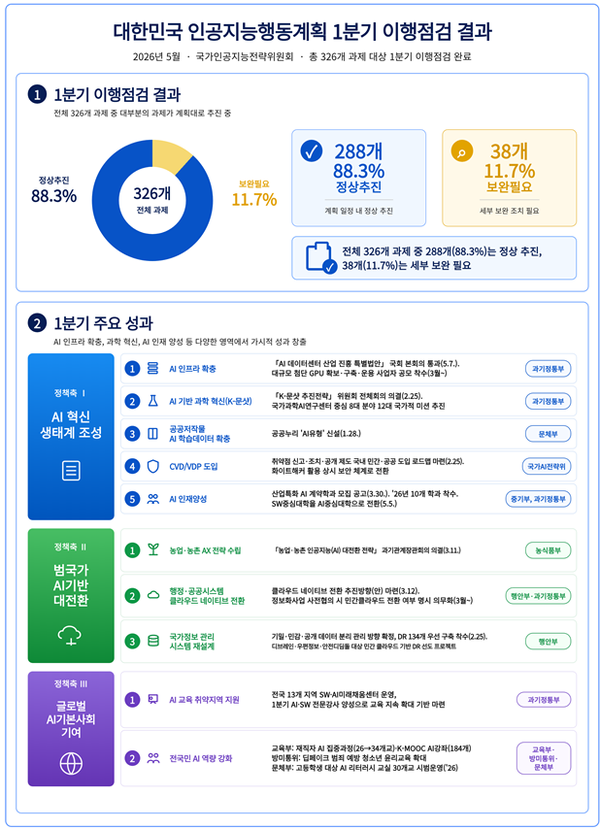
South Korea's National AI Strategy Committee said on Wednesday it completed a first-quarter review of 326 tasks under the "Republic of Korea Artificial Intelligence Action Plan".
After self-assessments by 31 lead ministries and expert reviews by 13 committee subcommittees, it found 288 of the 326 tasks, or 88.3 percent, were proceeding as planned. It judged the remaining 38 tasks needed supplementation. The committee called for revisions to details, the establishment of collaboration systems among multiple ministries and agencies, and securing budget funding for 2027 for those tasks.
In AI infrastructure, a special act on promoting the AI data centre industry passed the National Assembly plenary session on May 7. Of 13,000 advanced graphics processing units (GPUs) secured through a first supplementary budget for 2025, 4,000 are being allocated to industry, academia and research, 3,000 to national projects and 3,000 to the development of homegrown foundation models. Since March, it has also been running a tender for operators for large-scale GPU procurement, buildout and operations projects.
In scientific innovation, it approved the "K-Moonshot Promotion Strategy" at a plenary meeting on Feb. 25. It aims to solve 12 national missions across eight areas, including advanced bio, future energy, physical AI and space.
The Ministry of Culture, Sports and Tourism created a public Nuri "Type 0" that allows commercial use without an obligation to cite sources, and an "AI type" that can be used only for AI training. In security, it prepared a roadmap to introduce domestically a vulnerability reporting, remediation and disclosure system (CVD/VDP), in which white-hat hackers continuously find and report vulnerabilities and institutions address and disclose them.
In AI talent development, the Ministry of SMEs and Startups issued a recruitment notice in March for industry-specialised AI contract-based departments. It plans to cultivate employees at small and medium-sized firms into master's and doctoral-level AI research and development specialists, starting with the operation of 10 departments this year. The Ministry of Science and ICT converted seven universities from software-focused universities to AI-focused universities.
Bae Kyung-hoon (배경훈), vice chair and deputy prime minister for science and technology, said it confirmed each ministry was actively implementing the AI action plan and delivering results. Based on the first-quarter review, he said it would supplement and improve detailed implementation directions and repeatedly conduct periodic reviews to support the action plan taking root on the ground.
 Seul-gi Son
sageson@d-today.co.kr
Seul-gi Son
sageson@d-today.co.kr