
[DigitalToday reporter Seul-gi Son] A range of Korean artificial intelligence (AI) models is broadening its footprint in industrial settings, each building on its own strengths. Uses are diverse, including calling AI agents as well as translation and mobility.
The Ministry of Science and ICT said on May 11 that organisations from large companies such as LG AI Research, SK Telecom and Naver to startups including Upstage, Flitto, Motif Technologies and Mathpresso, as well as government institutions such as the Bank of Korea, are accelerating AI transformation (AX) with domestic AI models. Results from companies participating in the initiative for homegrown AI foundation models stand out.
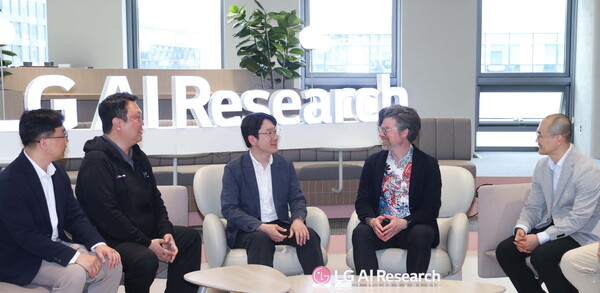
LG AI Research is deploying its AI model Exaone in LG Uplus’ AI agent IxiO for use during calls. IxiO does more than convert call content into plain text. It analyses conversational context and offers summaries that propose follow-up actions. It automatically organises and provides information that users need to confirm after a call, such as promised gift items or unit prices agreed with business partners.
Security features are also built in. To counter voice phishing that uses sophisticated tactics such as psychological pressure, IxiO detects risk signs in real time during calls and alerts users. Yu-cheol Kim (김유철), head of the strategy division at LG AI Research, said, "The most complete AI is born at the moment AI technology quietly seeps into people’s everyday lives."
AI data and solutions company Flitto additionally applied Solar Open, a homegrown AI model that Upstage developed by combining government support, to its real-time AI interpretation and translation solution Chat Translation. The structure improves both quality and processing speed by adding a domestically developed model to an existing interpretation and translation service.
Solar Open is an open source-based AI model released by Upstage. Combined with Flitto’s large-scale multilingual data, it was used to improve translation accuracy in real service environments. It is a case in which domestic AI technology has been applied to a commercial service.
SKT has released A.Dot Auto, an in-vehicle AI agent based on its own AI model A.Dot X. It is designed to let users carry out navigation, play music, control vehicle air conditioning and perform information searches using only voice while driving. It applied an agentic AI approach that processes multiple in-car functions sequentially in response to voice commands.
SKT plans to expand K-AI-based agentic AI to a range of industries and services beyond automobiles, starting with A.Dot Auto.
Math education company Mathpresso is pushing to apply Motif Technologies’ homegrown AI model to QANDA, an AI math learning service based on photographing problems. QANDA is used by millions of people in Korea and overseas. Once the model is applied, the service is expected to support students by analysing and explaining solution processes step by step so they can understand concepts and build skills on their own.
Motif Technologies is developing a large language model (LLM) with 300 billion parameters. It applied a proprietary training methodology designed to guide the model to learn logical flows on its own, from the pre-training data design stage through post-training. The approach is structured to first verify mathematical reasoning performance in small and mid-sized models and then extend the methodology to a large model.
Sung-min Lee (이성민), head of the AI group at Motif Technologies, said, "Motif’s AI model is focused on implementing the path of deep thinking that humans go through when solving complex problems." He added, "We hope it becomes a learning mentor that thinks through the parts students find difficult and helps them build the power to think for themselves."
A finance and economy-focused generative AI platform, Voki, built on Naver Cloud’s AI model, has been introduced at the Bank of Korea and is in operation. It is the first such case among the world’s central banks.
Voki offers document search and summarisation and question-and-answer functions for vast economic and financial documents as basic features, and also supports analysis of economic issues and data-based decision-making. The Bank of Korea plans to further train the system with its own data to advance it into an AI model specialised in finance and economics.
Naver Cloud said, "We expect K-AI to steadily prove its role even in the public finance sector, where security and trust are the top priorities, and to become a meaningful milestone for South Korea’s AX."
 Seul-gi Son
sageson@d-today.co.kr
Seul-gi Son
sageson@d-today.co.kr