
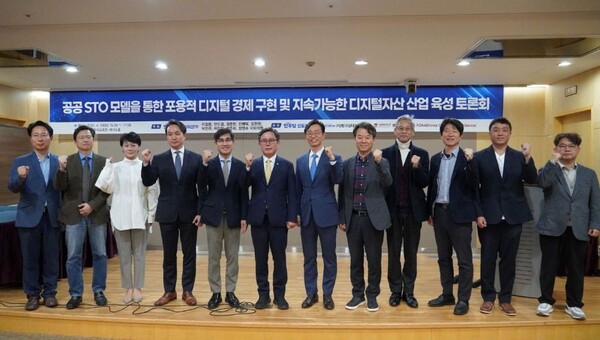
The Korea Fintech Industry Association held a forum on April 28 at the Leaders Hall of the Korea Institute of Financial Investment Education on implementing an inclusive digital economy and fostering a sustainable digital asset industry through public tokenised securities (STO) models.
Ahn Do-geol (안도걸), a lawmaker from the Democratic Party, said in opening remarks that STOs are drawing attention as a new financial infrastructure by enabling small investments through fractionalising real assets such as real estate, while strengthening market transparency and trust through blockchain-based trading structures.
Lee Jung-moon (이정문), a Democratic Party lawmaker, said that for public STOs to take hold in a stable way, the institutional foundation must be refined, including investor protection, disclosure obligations and conflict-of-interest prevention.
Kim Jong-hyun (김종현), chairman of the association, said it is time to discuss how to redesign capital market structures based on digital technology.
Inho (인호), a professor at Korea University's Blockchain Research Institute KDAA, said tokenised securities are a financial model that digitises real assets to improve funding structures and allow the public to share gains from public development. He said three models could build a structure linking development gains to public assets: a public housing welfare fund model, a pre-sale-linked model and a public dividend model.
Hong Seung-pil (홍승필), a professor at Hanshin University, said STOs could become a financial infrastructure that eases information asymmetry and prevents fraud by using blockchain-based information recording and verification structures. He stressed that tokenising jeonse deposits could secure liquidity and build a new real estate finance structure among landlords, tenants and financial institutions.
Ahn Chang-won (안창원), an IITP programme manager, presented an "STO technology development roadmap in the AI era" and said building public attestation infrastructure to support the expansion of a public-participation digital asset economy is a key task. He said digital asset infrastructure combined with AI-based automated disclosure and audit systems would be a key factor in securing future financial market trust and global competitiveness.
Participants agreed on the need to ensure trust and transparency based on digital technology and to build an inclusive asset formation structure. They also agreed discussions should continue on institutional improvements and market revitalisation.
 Ji-young Lee
ljy@d-today.co.kr
Ji-young Lee
ljy@d-today.co.kr