
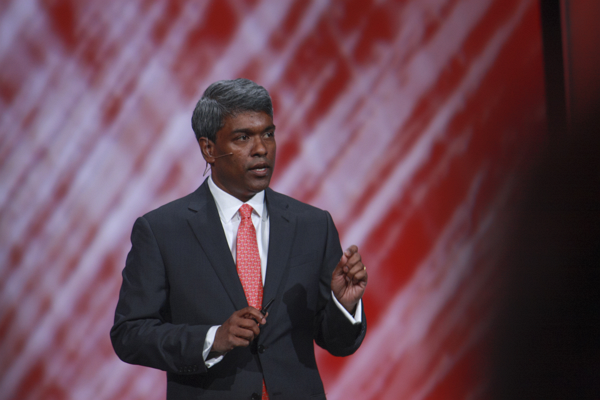
[Digital Today reporter Chi-gyu Hwang] Google Cloud CEO Thomas Kurian (토마스 쿠리안) voiced confidence that a “full-stack” AI strategy, in which it builds chips, data centres, foundation models and products in-house, can help it narrow the gap with Amazon Web Services in the cloud market.
In a recent interview with the Financial Times, he said, “We are not a hyperscaler that resells other companies’ technology.” He added, “The differentiator is that we own the intellectual property, the models and the chips.” He said, “We do not have to hand 80 percent of every $1 of revenue to model or chip suppliers, so we can invest more.”
In the eight years since Kurian, a former Oracle executive, joined Google, Google Cloud’s share of the cloud market has increased to 14 percent from 7 percent. Fourth-quarter 2025 revenue surged 48 percent from a year earlier, and the company expects revenue this year to exceed $70 billion. That would be a sharp increase from $43 billion in 2024.
Even so, Google Cloud is still third in the $418 billion cloud market behind AWS and Microsoft Azure. Some also assess that it lags OpenAI and Anthropic in chatbots and coding tools.
Kurian says Google’s TPU and Gemini models are ahead of Amazon’s Trainium chips and Nova AI models, and Microsoft’s Maia chips and MAI models.
He said TPU and Gemini reduce reliance on partnerships with Anthropic and OpenAI, or on Nvidia GPUs. He said, “Only Nvidia currently competes with Google as a company that has both AI chips and integrated chip software.”
Google Cloud recently unveiled 2 types of its eighth-generation TPU. One is specialised for AI model training, and the other focuses on speeding up AI inference by increasing memory. Epoch AI estimates Google holds about one quarter of the world’s AI computing power, with 3,800,000 TPUs and 1,300,000 GPUs.
Kurian said that as OpenAI and Anthropic battle to secure computing power while posting losses of billions of dollars annually, big tech companies that depend on them could also face risks. He said, “These AI suppliers are relying on a private capital market that is becoming saturated.” He added, “To go public, they cannot remain loss-making forever, and if they remain private, they cannot keep raising venture capital.” He said, “There will be a reshaping of the market within the next 1 to 2 years. Whether a particular supplier survives ultimately depends on economics.”
 Chi-gyu Hwang
delight@d-today.co.kr
Chi-gyu Hwang
delight@d-today.co.kr