
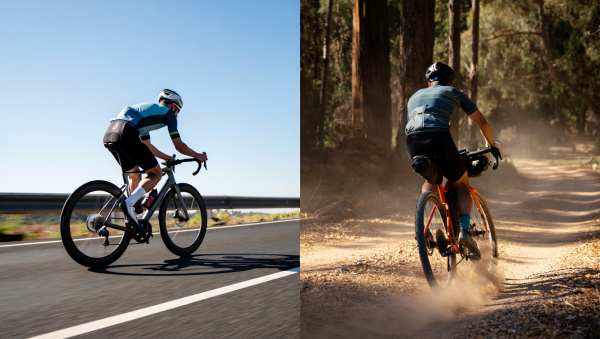
[Digital Today reporter Jinju Hong (홍진주)] Gravel bikes and road bikes look similar, but their purposes clearly diverge starting with tyre width and frame design. Whether a rider mainly uses paved roads or also covers unpaved surfaces determines the character of the two bikes.
According to mobility outlet BikeRadar on April 23 local time, road bikes generally use tyres around 28 mm, while recent endurance models go up to about 32 mm. Gravel bikes are designed to accept 35 mm or wider tyres, with some built to accommodate tyres up to 57 mm. That gives gravel bikes more clearance between the fork and frame, allowing stable riding in mud or on rough surfaces.
Frame geometry also sets them apart. Road bikes prioritise quick responses and nimble steering, while gravel bikes focus on stability and long-distance comfort. They use a longer wheelbase and a slacker head-tube angle to reduce wobble. As a result, gravel bikes encourage a more upright, near-vertical posture.
Component set-ups also differ by use. Road bikes mainly use aero handlebars and seatposts to reduce air resistance and improve pedalling efficiency. Gravel bikes, by contrast, use flared handlebars to boost stability and seatposts designed with vibration absorption in mind, and the range is expanding to include dropper posts and suspension. Some models have recently appeared with suspension forks offering up to 40 mm of travel.
Material choices in both markets centre on aluminium and carbon, but steel is relatively more popular in gravel bikes for durability and ride comfort. In high-end models, however, carbon still accounts for a large share.
In real-world use, the boundary between the two categories is gradually blurring. That is because endurance road bikes support wider tyres and a more comfortable riding position, allowing them to cover rough roads on dry days and even well-compacted unpaved sections. On trails mixed with mud, rocks and roots, however, gravel bikes show an advantage in stability and grip.
Speed also varies depending on riding conditions. On unpaved surfaces, gravel bikes have an edge thanks to higher grip and stability, but on paved roads road bikes are faster with their aero performance and lighter weight. Gravel bikes can also improve road performance by changing tyres, but their structural characteristics impose limits.
Gravel bikes have a wider range of uses. Wider tyres, disc brakes and room to fit mudguards make them suitable for winter riding and long-distance touring. Models that can mount racks and panniers can also be used to carry cargo. For that reason, pairing a single gravel bike with two wheelsets to handle both road and off-road riding is presented as a realistic alternative.
Set-up choices, however, require trade-offs. Advice has also emerged that riders with a high share of road riding should consider a 2x drivetrain to secure top speed.
In the end, the selection criteria are clear. Road bikes are suitable if speed and efficiency on paved roads matter, while gravel bikes offer broader versatility if a rider wants one bike to handle varied surfaces. The basic design differences in tyre width and frame geometry remain key factors separating the two categories.
 Jinju Hong
hongjj@d-today.co.kr
Jinju Hong
hongjj@d-today.co.kr