
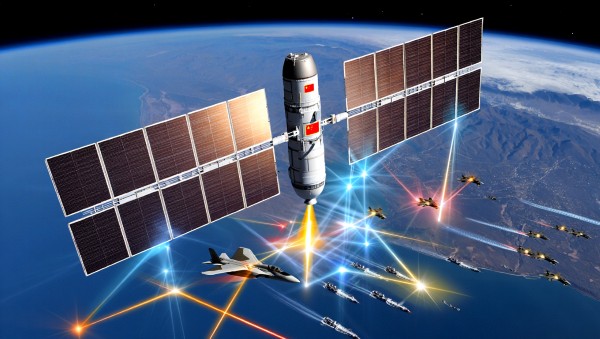
As assessments emerge that China has already developed and tested military technology capable of attacking the United States and its allies in space, the U.S. military is stepping up efforts to bolster its space power.
On April 23 local time, Cryptopolitan reported that the U.S. Space Force has defined China’s space military capabilities as a key threat and is pursuing its largest budget to date to respond.
Gregory Gagnon (그레고리 개그넌), the Space Force’s director of space warfare, said at an event in Canberra, Australia that China is operating the world’s largest space force and that its scale is about three times that of the United States. He said China’s pace of force expansion is "fast like a sprinter."
Gagnon explained that China had about 70 satellites in orbit in 2013, when President Xi Jinping took power, but the number has now increased to 1,400. "Space is no longer a supporting domain but a core battlefield," he said, claiming China has already developed weapon systems capable of attacking the United States in space and has even conducted training to operate them.
He also warned about the surveillance capabilities of Chinese satellites. He said Chinese satellites can already track the movement of U.S. and Australian forces on the ground and relay that information to long-range missile systems. Gagnon said that if a conflict occurs with China or Russia, the battlefield will inevitably expand into space because both countries have intentionally built capabilities to fight there.
This threat perception was also reflected in the Space Force’s official analysis. The report, "Future Operating Environment 2040," said a long-term, invisible conflict in space has already begun. It assessed that China aims to be on par with or ahead of the United States by 2040 through anti-satellite missiles, directed-energy weapons, robotic satellites and AI-based targeting systems.
It also said China is studying technology that uses a brain-computer interface, or BCI, to allow a single operator to control satellite swarms, and is developing methods to disguise satellite interference or GPS jamming as natural errors. This is interpreted as a strategy to gradually weaken an opponent’s capabilities rather than deliver a single strike.
The United States is therefore stressing the need to secure offensive response capabilities beyond defence. Gagnon said, "The United States and Australia should not be limited to defending space assets," and "We need to be prepared to neutralise an adversary’s space capabilities if necessary."
Australia, an ally, has also moved to respond, but the capability gap remains. A report released last week by the United States Studies Centre said Australia is lagging behind its allies in space capabilities and has no clear strategy to make up for it. Still, Australia plans to invest up to $12 billion in the space sector over the next 10 years to build a multi-orbit satellite communications system.
The scale of U.S. investment is far larger. The Air Force Department requested $338.8 billion for the next fiscal year, and the Space Force budget within that total is $71.1 billion, up 124 percent from a year earlier. Major items include space control systems at $21.6 billion, satellite communications at $6.7 billion, missile warning at $6.8 billion and satellite cyber defence.
Space Force Chief of Space Operations Chance Saltzman (챈스 솔츠먼) called the budget "a generational opportunity to secure superiority in space." The United States plans to respond to China’s expanding space power through investment across surveillance, communications and defence.
Experts say that as space emerges as a new core domain for military competition, it is increasingly likely to become a main stage for future strategic competition between the United States and China.
 Jinju Hong
hongjj@d-today.co.kr
Jinju Hong
hongjj@d-today.co.kr