
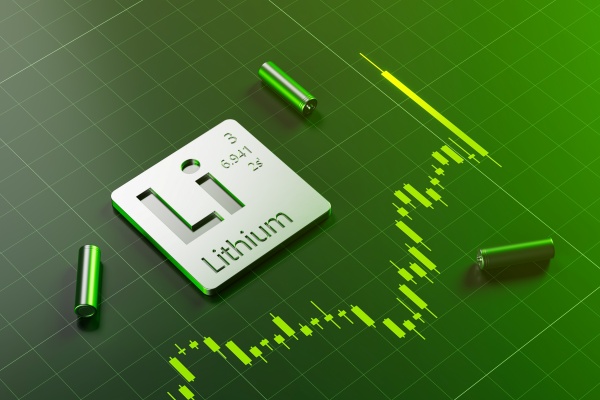
An analysis says the battery industry has begun a sector-wide uptrend starting in the first quarter of this year. The spot price of lithium carbonate rebounded more than twofold to the low $20s per kg in the first quarter from about $9 per kg at the end of last year. Strong energy storage system (ESS) installations supported demand while delays in restarting mines in China tightened supply, driving prices higher. From the second quarter, the lithium price rise is expected to be reflected in cathode material selling prices in earnest, leading to provision reversals and improved profitability.
According to Benchmark, a raw materials market research firm, the lithium carbonate price rebounded rapidly in the first quarter to recover to the low $20s per kg, up about 51 percent from a year earlier. The Asian spot price of lithium carbonate continued to fall throughout the second half of last year as inventories were steadily drawn down, at one point sliding to about $9 per kg at year-end. But with inventories not recovering as much as expected, some companies moved to secure stocks early this year, lifting short-term demand.
The direct cause of the rebound was restrictions on mine operations due to an environmental audit in Jiangxi province in China. Jiangxi is one of China’s major lithium-producing regions, and the audit under tighter waste regulations delayed mining schedules. Uncertainty over the timing of restarts fuelled speculative buying in the futures market, widening price swings.
Benchmark analysed that after ESS installations surged in December last year, strength continued into early this year, supporting a floor for demand. DS Investment & Securities saw ample likelihood that the lithium price strength will persist. It said lithium prices need to rise above at least $25 per kg for Western lithium refineries to start new investment, and that condition is not met at current levels.
That suggests a structure in which the West struggles to reduce its dependence on Chinese lithium will persist for the time being. China also has little incentive to rush mine restarts. Benchmark forecast that the lithium market will maintain a tight supply stance in 2026 and only ease in 2027 to 2028.
The broader industry recovery is also reflected in export indicators. According to Hanwha Investment & Securities, domestic cathode material export volume in the first quarter was 49,000 tons, up 8 percent from the previous quarter, and the export unit price rose 2 percent from the previous quarter to $23.7 per kg. By item, exports of NCA cathode materials reached 17,000 tons, a quarterly record high. A recovery in demand in Europe for electric vehicles (EV) and power tools and expanded shipments to the United States for ESS were cited as the main reasons.
Exports of NCM cathode materials rose 5 percent from the previous quarter to 32,000 tons. The absolute level is low, but the continued monthly recovery is viewed positively. U.S.-bound NCM cathode shipments hit a low in January after subsidies were halted in October last year, then entered a phase of gradual recovery in February and March.
From Q2, selling price reflection and provision reversals mark the early stage of a trend rebound
Profitability improvement is expected to become visible from the second quarter. Hanwha Investment & Securities forecast that higher lithium prices will be reflected in cathode material selling prices in earnest in the second quarter. The lithium carbonate price stabilised in the low $20s per kg in the first quarter, and this increase is beginning to be reflected in second-quarter contract prices.
LG Energy Solution is also moving to maximise shipments this year by bringing forward conversion lines. Expectations are also emerging that provisions accumulated by cathode material makers during last year’s low-price lithium period will be reversed sequentially as selling prices recover, further boosting the scale of profitability improvement. With other raw materials such as nickel, manganese and cobalt remaining stable, the cost environment is also working favourably.
DS Investment & Securities expected earnings estimates to be revised higher, led by cathode material companies, on provision reversals and rising selling prices. It judged that the impact of the EV slowdown is being brought to a close starting in the first quarter. It cited four grounds for a sustained rise in the battery sector: lithium price increases, expectations for big tech ESS orders, clearer Western energy security policies, and a rebound in BEV demand. With those factors gradually becoming more visible, DS Investment & Securities analysed that the sector is at the early stage of a trend upturn as results pass through a bottom.
Above all, it is important that details of a Korean version of the IRA, scheduled for June to July, are finalised and that the EU’s Industrial Acceleration Act (IAA) is confirmed. The period moving beyond the second half is expected to be a turning point that raises order visibility for domestic battery and cathode material companies. An industry official said, "The outlines of performance for cell and materials companies will only emerge once the scope and level of tax credits for domestic production are specified."
 Seok Dae-geon
d2dg@d-today.co.kr
Seok Dae-geon
d2dg@d-today.co.kr