
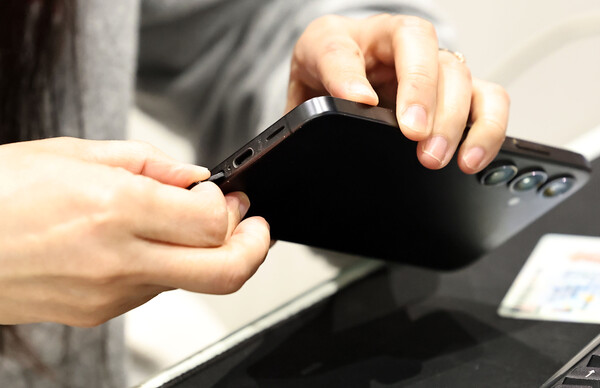
All three mobile carriers have moved to replace SIM cards over the past year, but market reactions have been mixed. SK Telecom ran into confusion in some cases due to supply shortages, while KT and LG Uplus carried out measures more quietly. The industry sees differences in the incidents that prompted the replacements and in response methods as behind the contrasting 분위기.
Same SIM replacement, different on-site 분위기
In April last year, news of a SIM hacking incident at SKT became known and confusion erupted on the ground. Anxiety spread as it emerged that SIM information linked to 23 million subscribers had been leaked. That quickly led to large-scale replacement demand and escalated into what was dubbed a “SIM crisis.” At the time, SKT could handle about 200,000 SIM replacements a day. But with reservation applicants swelling to several million, supply failed to keep up with demand.
SKT introduced SIM resets that do not require a physical SIM, but it did not fundamentally ease crowding because customers still had to visit stores. Long lines formed at airport roaming centres and stores, and the government recommended that it halt new subscriber sign-ups and focus on SIM replacement.
By contrast, KT, which suffered an unauthorised small-amount payment incident in the second half of the same year involving the misuse of ultra-small base stations (femtocells), carried out SIM replacement in a relatively calm atmosphere. LG Uplus is also carrying out SIM updates and replacements for all customers after it became known that it reflected customers’ phone numbers in the international mobile subscriber identity (IMSI), but on-site 분위기 has been stable. In the 10 days since April 13, the cumulative number of SIM updates and replacements exceeded 1 million, with no major on-site confusion.
Incident nature, user psychology split demand concentration
The industry analyses that differences in the nature of the incidents that triggered SIM replacement produced these results. SKT carried out SIM replacement as a post-incident response after a large-scale information leak. For users, unfamiliar security threats surfaced at once, including concerns over IMSI, the device identifier (IMEI) and SIM swapping. Demand for SIM replacement concentrated over a short period.
KT, by contrast, had a relatively limited scope of affected customers, and the perceived threat among users was lower than for SKT. LG Uplus also had less urgency because its move was a pre-emptive measure to strengthen security rather than a response to a hacking incident.
Differences in response strategies also mattered. The SKT case, which occurred first, served as a “learning effect.” KT began replacements on Nov. 5 last year in areas near 피해 sites such as Gwangmyeong and Geumcheon. It then expanded support sequentially on Nov. 19 to the Seoul metropolitan area, Gangwon and on Dec. 3 nationwide. It also offered a self-activation service via delivery for customers who had difficulty visiting dealerships.
LG Uplus opted for a strategy combining updates. From April 13 to 22, SIM replacements totalled 581,094 cases and SIM updates 427,385 cases. Demand of more than 400,000 cases was spread through online updates, easing the burden on SIM supplies. That helped reduce store crowding. LG Uplus is also offering visiting services, centred on islands and mountainous regions and senior welfare centres, to reach customers with low access.
Less confusion, but restoring trust remains a task
Still, fewer on-site disruptions does not translate into an assessment that the response was sufficient. Civic groups have evaluated LG Uplus’ steps positively, but have pointed to insufficient guidance and a low replacement rate as problems. The Consumer Sovereignty Council called for resending texts encouraging SIM replacement, expanding delivery services and a full inspection of security systems, citing risks in an IMSI structure based on phone numbers. LG Uplus’ cumulative replacement rate is still around 5.9 percent, leaving a significant number of subscribers yet to complete measures.
The industry says that if similar security issues arise, response strategies will need to comprehensively consider securing supplies, spreading demand and managing user perceptions. An industry official said, “Differences in subscriber psychology and post-incident response strategies determined whether demand concentrated.” The official added, “All three carriers should revisit crisis response manuals and procedures to reduce consumer inconvenience, building on their experience.”
 Jin-ho Lee
jhlee26@d-today.co.kr
Jin-ho Lee
jhlee26@d-today.co.kr