
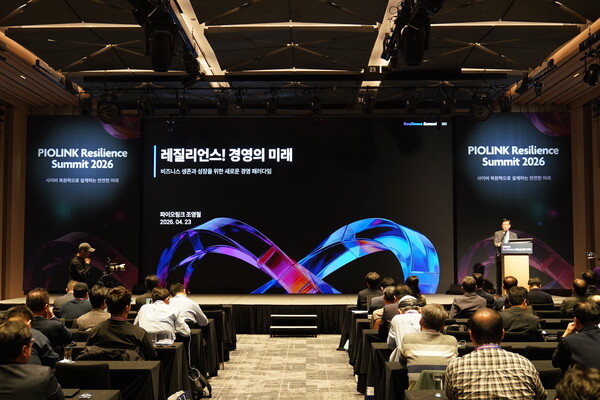
Piolink on April 23 held the “Piolink Resilience Summit 2026” at The Westin Josun Seoul Parnas and underscored its identity as a technology company that strengthens cyber resilience.
Cho Young-cheol (조영철), Piolink’s chief executive, said in a presentation titled “Resilience, the Future of Management” that resilience that sustains business even in a crisis is central to management for corporate survival and growth, beyond simple security defence. He made clear the company’s intention to become a specialist cyber resilience technology company that helps customers keep business running under any circumstances.
He cited incidents such as paralysis of administrative networks caused by a data centre fire last year, a telecoms data leak, personal information leaks, and a surge in ransomware. “In a hyperconnected era where the boundary between cyberattacks and disasters has collapsed, 100 percent perfect defence is impossible,” he said. “Now, beyond blocking, the essence is the ability to maintain services and business and to recover quickly even after an attack,” he said.
“As the nature of warfare is changing into a form that directly targets IT infrastructure such as communications networks, power grids and data centres, security is no longer an IT issue but an issue of management and survival,” he said. “If existing security was a ‘glass shield that breaks,’ going forward we need resilience like a ‘spring’ that absorbs shock and stands up again. Whatever the cause, how to get back on one’s feet quickly is the effective answer. Cyber resilience is not a cost but a core competitiveness,” he said.
Cho presented the four stages of cyber resilience from the U.S. National Institute of Standards and Technology (NIST) — anticipate, withstand, recover and adapt — as a corporate risk management framework. He also introduced a methodology for embedding resilience in management through core strategies.
On changes management should pay attention to, he said, “Security is not a consumable cost but sustainable competitiveness.” He said companies should not simply be relieved that incidents did not occur, but should manage as a management indicator the time it takes to restore core services when an incident happens. He said financial risk management is needed to reduce security debt and expand security capital.
He also said decision-making should be made by management by asking strategic questions centred on business value and establishing governance, and psychological stability should take root in the organisation through a blameless reporting system. Above all, he added, security maturity should be managed with a focus on improving fundamentals rather than short-term security results.
 Chi-gyu Hwang
delight@d-today.co.kr
Chi-gyu Hwang
delight@d-today.co.kr