
Samsung Electronics and POSTECH said on Wednesday they have implemented, for the first time, a metasurface display technology that switches between 2D and 3D screens using only voltage control. The two institutions conducted the research through industry-academia cooperation between Samsung Research's Visual Technology Team and POSTECH's Nanoscale Photonics & Integrated Manufacturing Laboratory. The research paper was published in the international journal Nature.
The technology uses an ultra-thin lens made of arrays of nanoscale structures, called a metasurface lenticular lens (MLL). It switches between 2D and 3D modes by changing the lens' focal characteristics through control of light polarization direction.
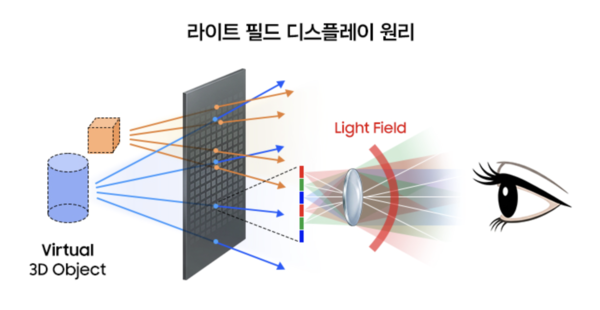
Conventional light-field displays have been researched in areas including AR, medical imaging and entertainment because they can deliver 3D images without glasses. But lens thickness has been large and the 3D viewing angle narrow at about 15 degrees. Constraints on practical use were also significant, including reduced image resolution and the need for an eye tracker. The research team designed its own polarization-controlled metalens to address these limitations.
When a polarization modulator positioned in front of the display is turned on, the metalens switches to a concave lens and cancels the refractive power of an existing convex lens. The opposing forces of the two lenses combine to create an optical state of zero, and light travels straight as if passing through flat glass. As a result, a high-resolution 2D image is produced. When the polarization modulator is turned off, the metalens switches to a convex lens and, together with the existing lens, exerts stronger refractive power to enhance 3D depth.
The metasurface lenticular lens developed in the research maintained a thickness of 1.2 mm while achieving a viewing angle of 100 degrees. That is more than six times wider than 15 degrees. It adopted a high numerical aperture design to reduce the volume of optical devices while securing a wide viewing angle. With a wider viewing angle, multiple people can watch 3D images at the same time.
The team produced a large-area metalens measuring 50 mm by 50 mm (25 square cm) and applied it to an OLED display panel, which is mainstream in the mobile market, to verify the technology's completeness. It confirmed the possibility of integration into an actual panel beyond a concept level. The company said it could be reviewed for use in consumer electronics such as smartphones and tablets, as well as commercial display systems.
 Daegeon Seok
d2dg@d-today.co.kr
Daegeon Seok
d2dg@d-today.co.kr