
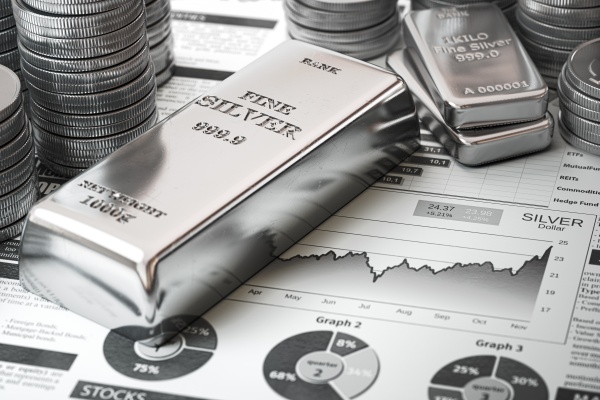
Silver has posted a stronger rise than gold so far this month, tilting leadership in the precious metals market toward silver.
On April 22, blockchain outlet BeInCrypto reported that silver has risen 15.47 percent this month, far outpacing gold’s 6 percent gain. With Brent crude falling below $99 a barrel, the gold-silver ratio, options positioning and chart structure are all sending signals that favor silver.
The first indicator drawing attention is the gold-silver ratio. Since late March, it has formed an inverse cup-and-handle pattern and has now fallen to near the lower trendline of the handle. If it drops below 58, the ratio could compress by another 16 percent, widening silver’s relative advantage. If it returns to 68, momentum could tilt back toward gold.
Internal indicators tied to supply and demand also point in the same direction. The “Solar Lag model,” which reflects industrial demand for silver, has moved above the zero line for the first time since late 2025. A previous upside break in late November last year was followed by several weeks of a silver rally. By contrast, an indicator comparing gold with the 10-year real yield fell from 2.685 in early April to 0.308 recently. That signals gold’s monetary premium is weakening.
Still, gold has a defensive line in place. Data cited by analysis firm Kobeissi Letter show central banks hold about 38,666 tons of gold, about 17 percent of all gold ever mined. Central bank demand is acting as a backstop that limits declines rather than pushing gold prices higher.
The derivatives market has also tilted toward silver. The put-call volume ratio for SLV, a major spot silver exchange-traded fund, fell to 0.49 on April 21 from 0.77 on March 26. A ratio below 1 means call options outnumber put options. The open-interest ratio also fell over the same period, to 0.56 from 0.60. This suggests investors are betting more actively on higher silver prices.
In contrast, GLD, a spot gold ETF, did not show a clear shift to aggressive buying. The volume-based put-call ratio fell to 0.87 from 1.35, shifting from bearish to neutral or mildly bullish, but the open-interest ratio was little changed at 0.54 from 0.53. That means demand for downside protection in gold has eased, but it has not attracted strong upside bets like silver.
Charts also show differences between the two assets. Silver is forming an inverse head-and-shoulders pattern on daily charts. The head is near $60 and the neckline is around $80. In the right-shoulder area, buy volume slightly exceeded sell volume, producing a bullish confirmation signal. A decisive break above the $80 to $83 zone would open about 43 percent upside, with a target around $115. An additional extension target is $133. If it slips below $75, the structure weakens, and if it falls below $69, the likelihood grows that the pattern is invalidated. If $60 breaks, the bullish scenario ends.
Gold is forming a similar pattern, but confirmation is weaker. The neckline is around $4,848, and a break above it would open about 24 percent upside, targeting $5,934 an ounce. In the right-shoulder area, sell volume exceeded buy volume, sending the opposite signal from silver. The upside potential is also about half that of silver.
An analysis says silver is currently ahead of gold in volume confirmation, options flow and expected gains. Gold, however, has central bank buying acting as a defensive line supporting the downside. As a result, if silver breaks above $80, its advantage could become clearer, but if it fails at that level and falls below $75, market leadership could tilt back toward gold.
Central banks are sitting on massive stockpiles of gold after years of record purchases: Global central banks now hold ~38,666 tons of gold, reflecting ~17% of all gold ever mined. Still, the largest portion of gold remains in private hands, with ~97,645 tons held as jewelry,… pic.twitter.com/J5YXv8AMkn
 Yoonseo Lee
yslee@d-today.co.kr
Yoonseo Lee
yslee@d-today.co.kr