
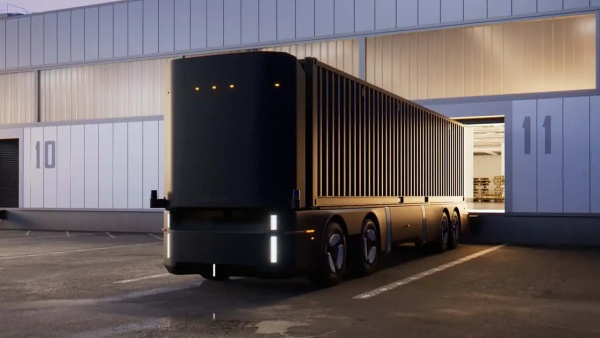
Humble Robotics has unveiled the Humble Hauler, an electric autonomous freight platform that eliminates the driver’s seat entirely.
InsideEVs reported on April 22 that the vehicle is a Class 8 electric platform focused on automatically moving cargo in closed or controlled logistics environments such as warehouses, rail yards and ports. It targets repetitive, standardised hub logistics routes rather than long-haul highway transport.
The biggest change is the complete removal of the conventional heavy-truck cab. Humble Robotics said this can improve use of cargo space, simplify the structure and lower costs. The vehicle is designed as a platform-style trailer with an integrated power unit rather than a traditional tractor-trailer combination, and it can be configured in various forms to match logistics companies’ operating models.
The vehicle’s structure is also adjustable. It uses a universal lock-and-twist interface that allows the length to be extended or shortened, enabling configurations ranging from a six-wheel concrete mixer to an eight-wheel container carrier. If needed, it can also be towed by an existing tractor vehicle, securing compatibility with existing infrastructure.
Performance is optimised for short-range logistics automation. Based on 2 electric axles, it has a maximum range of about 200 miles (about 321 km) and a top speed of 55 miles per hour (about 88 kph). The design suits repeated movements inside ports or between logistics hubs rather than long-distance transport. The first prototype was also developed to move containers at ports without human intervention.
The company is targeting Level 4 autonomous driving. Its sensor suite combines cameras, lidar and radar for 360-degree awareness around the vehicle, and it applies an in-house model integrating vision, language and action. The company said the model helps the vehicle understand its surroundings and make appropriate decisions even in unfamiliar environments.
The cabless structure also benefits the autonomous-driving design. With fewer constraints from conventional vehicle design, such as turning radius and body proportions, it can set more efficient routes and use space more effectively. It also reduced the platform’s weight by about 20 percent compared with a conventional semi-truck.
The management team is also made up of people with experience in related fields. Humble CEO Eyal Cohen (에얄 코헨) previously worked on developing autonomous driving, electric vehicles and logistics technology at Apple, Uber and Wayve, and stressed that "for the first time, a foundation has been laid for freight to be fully automated all the way to the loading dock."
Commercialisation preparations are also under way. Humble Robotics is running autonomous driving tests and pilot programmes with logistics and supply-chain companies, and it raised $24 million in a seed funding round led by Eclipse. Energy Impact Partners and others also participated in the investment.
The unveiling differs from the trend of established automakers such as Tesla and Daimler developing highway-focused autonomous trucks, in that it targets a more practical market for hub logistics automation.
The future success of the Humble Hauler is expected to hinge on how efficiently its variable platform can perform in real operating environments across different cargo types, and whether it can connect autonomous-driving pilots to stable commercial services.
 Jinju Hong
hongjj@d-today.co.kr
Jinju Hong
hongjj@d-today.co.kr