
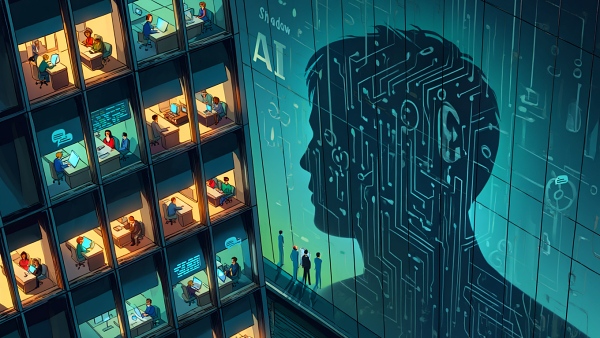
Unofficial, untracked use of AI inside financial institutions, known as shadow AI, is spreading across everyday work. On April 22, fintech outlet Finextra reported that the core problem is not AI use itself but organisations being unable to grasp what data employees enter, where and how often.
In workplaces, AI is already being used as a real work tool beyond pilot programmes or limited experimental settings. Customer service staff use AI to refine email wording, analysts summarise long reports, and teams draft internal documents faster. Because these uses do not individually appear to be policy breaches or incidents, they spread faster.
Employees use AI with only a browser and prompts, without separate procurement procedures, adoption processes or system integration. Experiencing a productivity boost and not returning to the old way also encourages wider use.
Many financial institutions have already 마련ed guidelines for AI use, and some are also restricting access to public tools. Employees, however, обход such limits by using personal devices and retyping sensitive content rather than copying and pasting it. This is not so much to evade controls as it is because the old way is slower while performance demands remain unchanged.
A bigger problem is that such use is hard to see. Entering customer information to adjust a sentence’s tone, pasting an internal report to summarise it, and adding sensitive contextual information to get better results do not individually trigger alerts. But as these small actions add up, they create exposure patterns that are hard to handle with existing control systems.
Shadow AI also differs from traditional shadow IT. The issue is not only where data goes but how information is transformed in real time. Multiple sensitive details can be combined and reconstructed in a single prompt and then sent outside an organisation in seconds, and unlike existing systems, there are often no audit logs for compliance departments to check.
This is also shaking the assumption that risks can be contained with policies and blocking alone. Financial institutions face a need to shift from restriction-focused responses to securing visibility, from static policies to real-time control, and from assumed compliance to checks of observable behaviour. Because internal AI use can quietly accumulate without central coordination, the same actions may have continued for months by the time they surface as official incidents.
The core issue is not whether AI is used but that an organisation’s control methods are failing to keep up with actual workplaces. Shadow AI has quickly taken hold as a productivity tool, leaving financial institutions with the task of first building systems to detect and manage traces of its use.
 Hyunwoo Choo
cookinpapa@d-today.co.kr
Hyunwoo Choo
cookinpapa@d-today.co.kr