
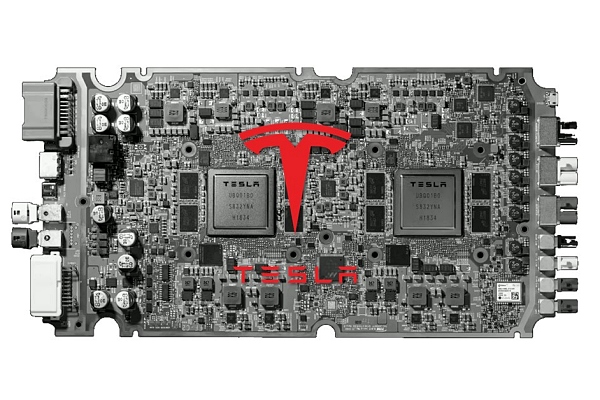
Tesla has officially acknowledged it cannot implement unsupervised Full Self-Driving (FSD) on existing HW3 (Hardware 3) vehicles, shaking the direction of its autonomous driving strategy at its core. The launch timeline has also slipped, bringing hardware transitions and compensation issues to the fore.
On April 22 local time, Elon Musk (일론 머스크), Tesla's chief executive, said on the company's first-quarter 2026 earnings conference call that "HW3 does not have the ability to achieve unsupervised FSD," InsideEVs and Electric reported. He said HW3's memory bandwidth is about one-eighth that of HW4, making it difficult to handle the computing needed for full self-driving.
About 4 million Tesla vehicles are currently operating on an HW3 basis, including customers who purchased FSD as an option. As a result, unsupervised autonomous driving will not be available on existing vehicles, making vehicle replacement or hardware upgrades effectively unavoidable.
Tesla is responding by steering customers toward HW4-based vehicles. For customers who bought FSD, it plans to offer discounted trade-ins for HW4 vehicles, and to support hardware replacements including the computer and cameras for those keeping their existing cars. Critics say this process is closer to a vehicle retrofit than a simple parts swap, limiting how quickly existing service centres can handle the work.
Tesla is therefore considering building dedicated retrofit hubs in major cities in the form of microfactories. Musk said handling it only at service centres would be very slow and inefficient, and that small production lines are needed. He also hinted at a long-term plan to convert the entire fleet of HW3 vehicles to HW4.
The autonomous driving rollout schedule has again been pushed back. Musk delayed the launch of unsupervised FSD for consumer vehicles to the fourth quarter of 2026. That is a further delay from previous expectations. Tesla cites region-specific conditions such as complex intersections, imperfect lane markings and weather variables, and says it will expand the feature gradually starting with areas where safety is proven.
On the software side, a structural overhaul will proceed in parallel. Tesla plans to fully shift its next-generation FSD v15 to a "pure AI-based" architecture, aiming for release late this year or early next year. The company stressed that key structural improvements are needed to significantly raise safety before a large-scale rollout.
The announcement shows limits in Tesla's long-promoted strategy of completing autonomous driving solely through software updates. With HW3 vehicles effectively excluded from unsupervised FSD, disputes are likely to grow over the scope of compensation for customers who bought FSD in advance, upgrade costs and criteria for eligibility.
In the end, three points narrow the focus going forward: the speed of the HW4 transition and infrastructure buildout, the actual launch timing for unsupervised FSD, and compensation policy for existing customers. An assessment is emerging that, as it nears commercialising autonomous driving, Tesla has put technology, cost and trust issues to the test at the same time.
 Jinju Hong
hongjj@d-today.co.kr
Jinju Hong
hongjj@d-today.co.kr