
Dell Technologies, through two reports published jointly with Intel and market research firm IDC, assessed that Asia-Pacific companies have moved beyond experimenting with AI adoption and entered a full execution phase. It also emphasised the growing role of AI PCs and workstations.
Dell projected that 69 percent of surveyed companies in Korea cite AI functions as an essential criterion when buying PCs, and 72 percent expect their number of workstations to increase over the next 5 years.
As enterprise AI expands across client devices, edge environments and data centres, companies are increasingly adopting strategies to place computing resources where they best fit the nature of their work, Dell said.
The reports cited by Dell include analysis of AI PC and workstation adoption in Asia-Pacific companies and the future direction of infrastructure strategy.
The AI PC report, titled "Future-Ready Workforce: Strategic Rationale for AI PC Adoption," and the workstation report, titled "Forward-Looking Computing Delivered by Workstations," analysed survey results from IT and business decision-makers in Asia-Pacific in October 2025. The AI PC report had 720 participants, and the workstation report had 960.
AI PCs are characterised by processing AI workloads locally, reducing reliance on the cloud and improving response speed.
The survey showed that AI PC adoption among companies in Korea is 37 percent, slightly below the Asia-Pacific average of 48 percent, but awareness of the negative business impact of delays in adopting AI PCs is high. Some 33 percent of respondents expressed concern that delays could lead to key talent leaving for competitors, while worries about increased operational inefficiency and rising costs, at 33 percent, and loss of market leadership, at 32 percent, also exceeded the Asia-Pacific averages.
Some 69 percent of respondents in Korea said AI functions are the most important or essential criterion when purchasing PCs. That is about 13 percentage points higher than the Asia-Pacific average of 56 percent, and indicates AI PC adoption in Korean companies will accelerate, Dell said.
Respondents in Korea cited security, at 64 percent, ecosystem and ISV certification, at 59 percent, and total cost of ownership, at 53 percent, as key considerations when selecting an AI PC partner.
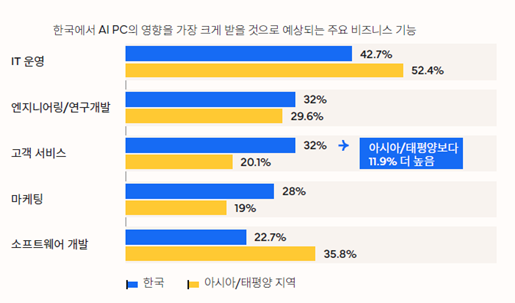
Asked which major business functions are expected to be most affected by AI PCs, companies in Korea ranked IT operations first at 42.7 percent. They next selected customer service at 32 percent along with core areas such as engineering and research and development at 32 percent, which is 11.9 percentage points higher than the Asia-Pacific average of 20.1 percent.
Among Asia-Pacific companies with AI PC adoption exceeding 50 percent, productivity increased by 30 percent compared with using general PCs, resulting in an average daily reduction of 2.17 hours of work time per employee, the survey found.
Some 80 percent of Asia-Pacific respondents said the safe and consistent work environment provided by AI PCs will accelerate company-wide adoption of agentic AI.
While AI PCs improve efficiency across workplaces, workstations are drawing attention as infrastructure for high-performance AI work. Some 97 percent of Asia-Pacific respondents selected workstations as the high-performance solution needed to use AI and ML models, and 72 percent of respondents in Korea projected their number of workstations will increase over the next 5 years.
The survey showed that more than half of companies in Korea are widely using workstations for AI workloads. Specifically, they use workstation performance for complex tasks such as data preparation, at 57 percent, and model fine-tuning, at 52 percent.
In the Korean market, it also stood out that respondents selected long-term cost efficiency as a key criterion for choosing workstations. Dell emphasised that this shows discussions on AI adoption are evolving from a narrow focus on initial purchase price to total cost of ownership, including lifecycle, scalability and reliable performance.
Kyeong-jin Kim (김경진), country manager of Dell Technologies Korea, said, "AI PCs and workstations are key platforms opening the next stage of enterprise AI." He said companies can effectively build distributed AI environments based on workloads through the complementary combination of AI PCs close to workplaces and workstations handling high-performance computing, while strengthening security and privacy protection and creating tangible business results.
 Chi-gyu Hwang (황치규)
delight@d-today.co.kr
Chi-gyu Hwang (황치규)
delight@d-today.co.kr