
Nvidia has chosen South Korea as the first demand base for the autonomous AI agent market. It is promoting a bundle of NemoClaw, which wraps the open-source framework OpenClaw in its own secure runtime, and DGX Spark, which runs it locally. The strategy is to absorb demand with a full stack from software to hardware. As concerns grow about API costs from always-on agents and about security, the benefits for Nvidia's lineup are expected to become clearer.
Nvidia on April 21 held 'Nemotron Developer Days Seoul 2026' in South Korea and introduced a hands-on programme called 'Build-a-Claw'. The programme, unveiled at GTC 2026 in San Jose in March and drawing developers' interest, is being held first in South Korea among major global markets. An Nvidia official explained that it chose South Korea as the first location because it is the market with the highest sensitivity to AI responses.
Nvidia's stack spans three layers: OpenClaw, OpenShell and NemoClaw. According to an on-site explanation by Nvidia's head of technology, OpenClaw is an open-source framework that assigns roles and history data to various agents, forms them into groups and orchestrates them. According to an Nvidia official, its approach differs from existing AI agents in that it is a tool that automates based on collective intelligence rather than a single intelligence. Nvidia CEO Jensen Huang (젠슨 황) last month described OpenClaw at GTC as "the most popular open-source project in human history" because of that scalability.
Giving agents broad authority also brings risks. Concerns have been raised that data could leak outside corporate IT systems, that outsiders could take data out, or that agents could damage the system itself.
Nvidia's answer is OpenShell, a container-type security solution. It confines agents and the OpenClaw environment to operate only within a restricted space. The guardrails Nvidia built span three areas: network sections connected to external services such as MCP, API and CLI; the development environment where simulation and information search take place; and the skills granted to agents.
It also prevented sensitive information such as floating licence key values from being exposed to users or agents by allowing access only through internal variables. NemoClaw is the service that packages the OpenClaw ecosystem to run at an enterprise level on top of OpenShell.
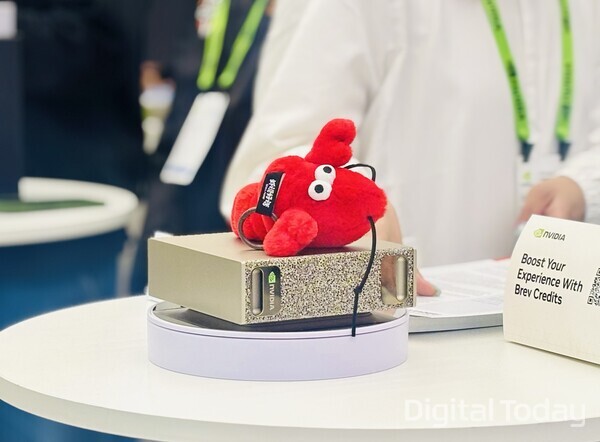
Nvidia's aim does not stop at the software layer. Because always-on agents accrue costs each time they call external APIs, demand follows for hardware that can run large models locally. DGX Spark, which Nvidia is promoting for individual developers, is positioned as a personal AI supercomputer that can run a 120 billion-parameter model locally without API costs.
Nvidia said its design, in which the CPU and GPU share a single memory, is advantageous for loading and deploying large models. Comparing DGX Spark with the Mac mini, an Nvidia official said, "The Mac mini is not based on Nvidia software and has a low-spec GPU, so it is difficult to run high-performance LLMs," adding, "If you connect and use an always-on assistant model via an API, costs are high, so we recommend DGX Spark."
Use cases differ for companies. It can be used by building an on-premises data centre cluster in a Kubernetes-based high-availability configuration and providing isolated environments for individual users with OpenShell. Examples also include forming agent groups by team or working group and integrating them with existing communication channels such as Slack. Nvidia also said it uses OpenClaw internally by forming agents that take on roles including secretary, technical team lead, researcher, engineer, solutions architect, QA, ops and HR to plan and run projects.
◆Nvidia hardware gains as API cost burden and security concerns rise
NemoClaw is deployed with a single command not only on cloud and on-premises environments but also on GeForce RTX PCs and laptops, RTX Pro workstations, DGX Spark and DGX Station. Installation finishes with one line of command and the basic environment is set automatically, but users must build the agent tree and graph design themselves to match their work style. Proposed uses include automation that crawls major AI news from the web every morning and sends a summary email, CI/CD pipeline validation that runs on each commit, and generating simulation reports based on capacity changes at manufacturing sites.
The key is how quickly demand for local AI is pulled into Nvidia hardware. As more developers, teams and companies seek to run always-on agents while avoiding API costs, the benefits for DGX Spark and the RTX lineup could begin in earnest. South Korea being selected as the first global host of Build-a-Claw is interpreted as a move to pre-empt demand in the same context.
Ideas for use cases also expanded quickly at the GTC venue in March. Defence logistics startup GallatinAI is reviewing a Claw that rewrites multiple newsletters into a single personalised version, Dutch research institute TNO is considering a use case that periodically scans the latest papers and delivers a weekly report, and AI-native consulting firm Groove is reviewing more than 10 ideas including a Claw that interviews colleagues at a conference site on a user's behalf and organises insights.
Still, there is also a hesitant mood about deploying it in real work. For Claw to serve as a true secretary, it must access login information and a broad range of internal materials, increasing the security burden. Nvidia also recommended that "for the time being, operate it in isolation on a separate device." That means more time is needed before on-site adoption, and Nvidia's decision to hold a hardware experience event in Seoul in haste is read as a pre-emptive move that takes that time gap into account.
 Seok Dae-geon
d2dg@d-today.co.kr
Seok Dae-geon
d2dg@d-today.co.kr