
A South Korean research team has developed what it called the world’s first display technology that can freely switch between 2D and 3D without glasses simply by attaching it to a smartphone.
The Ministry of Science and ICT said on April 23 that a team led by Jun Seok Rho (노준석), a professor at Pohang University of Science and Technology, and Samsung Electronics’ Samsung Research Visual Technology Team jointly developed a technology that uses a next-generation optical device, a “metalens,” to switch freely between 2D and 3D with a single lens.
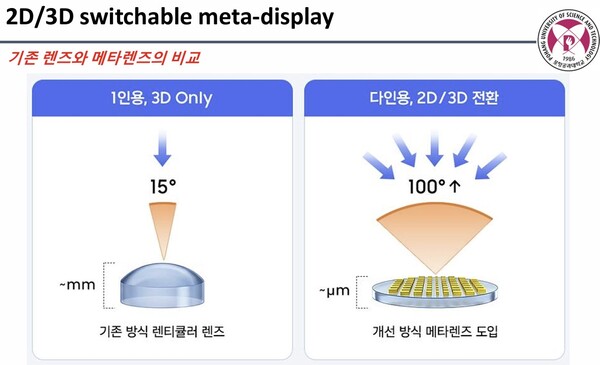
Glasses-free 3D technology has existed, but there have been barriers to commercialization. One drawback was a very narrow viewing angle of around 15 degrees. Another was that because devices were designed exclusively for 3D, image quality dropped sharply when viewing a normal 2D screen.
The team solved these problems with a metalens designed in an ultra-thin 1.2 mm structure. A metalens is an ultra-thin planar optical device that implements lens functions by arranging artificial nanostructures of nanometer size on a substrate and precisely controlling the phase, amplitude and polarization of light.
A conventional lens cannot change its characteristics once made, but a metalens can freely adjust the direction of light refraction depending on voltage supply. With no voltage, it operates as a concave lens and shows a high-resolution 2D screen without distortion. When voltage is supplied, it operates as a convex lens and produces a stereoscopic image with an ultra-wide viewing angle of 100 degrees, more than 6 times wider than existing technology.
In particular, the metalens delivers its performance by simply being attached like a sticker to a smartphone or tablet PC screen. With very strong compatibility with existing devices, it is expected to be applied widely in the future, from mobile devices to precision medical imaging systems and large outdoor billboards.
The research results, carried out through projects supported by the ministry as well as the Samsung Future Technology Incubation Program, POSCO Holdings’ N.EX.T Impact program, and Samsung Research industry-academia collaboration tasks, were published in Nature on April 23.
Rho, who led the research, also presented practical commercialization potential by, along with this technology, putting forward “mass production process technology for metalenses,” which he recently published in Nature as a co-corresponding author with Gyu-jin Cho (조규진) and In-gi Kim (김인기), professors at Sungkyunkwan University. The two papers are scheduled to be published together in the Nature issue to be released on April 30.
It is the first time that a South Korean researcher has simultaneously published two different studies as a corresponding author in an issue of the world’s most authoritative journal, the ministry said.
Rho said, “This research is an achievement that demonstrates the practical potential of metalenses as a next-generation display platform,” and added, “It will contribute to securing foundational display technology with broad applicability from smartphones to industrial billboards.”
Seong-su Kim (김성수), director-general for R&D policy at the Ministry of Science and ICT, said, “Professor Rho is a researcher who has conducted early-career and mid-career research for more than 10 years through the ministry’s basic research program,” and added, “We will continue to support researchers so they can fully demonstrate their capabilities on the global stage through steady investment in basic research.”
 Jin-ho Lee
jhlee26@d-today.co.kr
Jin-ho Lee
jhlee26@d-today.co.kr